
In recent years, those following the international auction market may have noticed an interesting phenomenon:…

The Way of Wisdom of Shakyamuni Buddha
The wisdom of Shakyamuni Buddha is not an abstract theoretical system, but a practical philosophy that directly addresses the essence of life and guides sentient beings out of suffering. Its core revolves around the “Four Noble Truths”, “Eightfold Path” and “Dependent Origination and Emptiness”. The three are interconnected, revealing the root cause of life’s suffering and providing a specific path to transcend suffering, ultimately pointing to spiritual enlightenment and freedom.

The “Four Noble Truths” are the cornerstone of Buddhist wisdom, helping sentient beings to understand the true nature of life. The first, the Truth of Suffering, does not deny life’s fleeting joys, but rather confronts the true nature of suffering—birth, aging, sickness, and death, the unfulfilled desires, the separation of loved ones, and the reunion with those we hate—awakening a clear understanding of life’s impermanence. The second, the Truth of Origin, delves into the root of suffering: craving—the pursuit of fame and fortune, the obsession with emotions, and the clinging to the self. These attachments, like shackles, trap us in a cycle of suffering. The third, the Truth of Cessation, offers the possibility of liberation, clarifying that suffering can be ended by eliminating craving, leading to nirvana. This is not the end of life, but a state of inner enlightenment free from suffering and tranquility. The fourth, the Truth of the Path, points to a practical path, stating that only by practicing the Eightfold Path can we gradually eliminate craving and achieve nirvana.
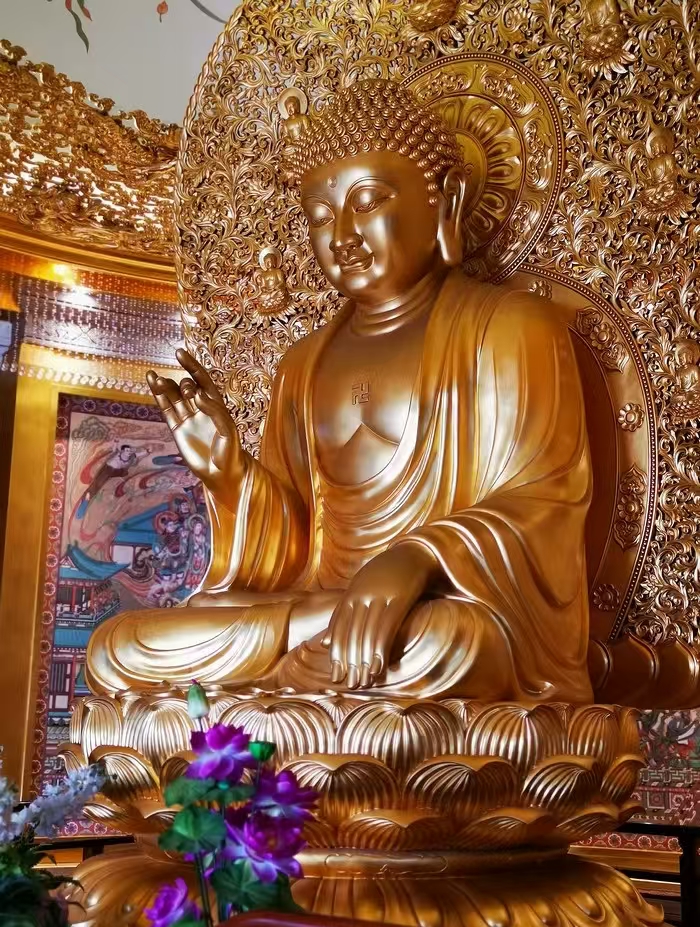
The “Eightfold Path” is the core of wisdom implementation, and it constructs a complete practice framework from thinking to behavior. From a cognitive perspective, we need to establish “right view” and correctly understand the Four Noble Truths, cause and effect, impermanence and other truths to avoid being misled by appearances; at the same time, we need to develop “right thinking”, stay away from hatred and greed, and cultivate a pure mind of compassion and selflessness. Behaviorally, one must practice Right Speech (refraining from lying or abusive speech), Right Action (refraining from killing, stealing, or sexual misconduct), and Right Livelihood (earning a living in a way that harms no one), ensuring that one’s words and actions are consistent with morality and goodwill. From the perspective of spiritual practice, one needs to maintain “right diligence”, balance effort and laziness, neither blindly practice asceticism nor indulge in laziness; one needs to adhere to “right mindfulness”, always be aware of the body, emotions and thoughts, and not be overwhelmed by distracting thoughts; one needs to practice “right concentration”, through meditation training, let the mind be focused and stable, and cultivate wisdom in concentration.

“Dependent Origination and Emptiness of Nature” is the underlying logic that runs through Buddhist wisdom. It points out that all things are composed of causes and conditions, and there is no eternal and unchanging “self-nature” (fixed essence). Whether it’s the external mountains, rivers, plants, or the internal “self,” everything is in a state of constant change. By seeing clearly the “dependent origination and emptiness of nature”, we can let go of our attachment to appearances, understand that suffering comes from the delusion of “permanence”, and then fundamentally eliminate greed and attachment, forming a closed loop with the “Four Noble Truths” and “Eightfold Path”, and ultimately achieve spiritual enlightenment and live a life of freedom and coolness.
Related Posts