In recent years, those following the international auction market may have noticed an interesting phenomenon:…
The Radiant Faith: A Thousand-Year Legend of Illuminated Manuscripts
In the dimly lit halls of medieval Europe, a single book could be worth as much as a vineyard. Those that shimmered with gold and silver and blazed with vibrant colors—the illuminated manuscripts—were treasures among treasures. They were not merely vessels for text, but projections of faith, symbols of power, and miraculous works of art that have traversed time. Today, let us step together into this luminous world and trace the thousand-year legend of the illuminated manuscript.
What is an Illuminated Manuscript?
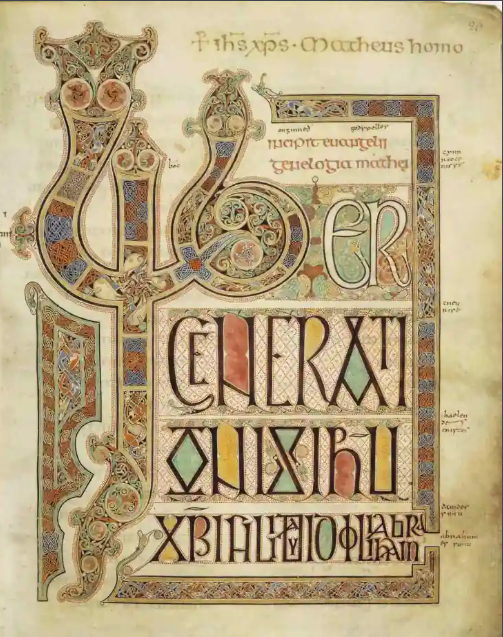
In the West, these works are known by the evocative term “illuminated manuscript,” specifically referring to manuscripts decorated with gold or silver. In its strictest definition, the term applies to manuscripts embellished with these precious metals, but in common usage, it has come to encompass any manuscript with decorations or illustrations.
These codices are characterized by illuminated initials and border ornaments created using metal-leaf techniques, typically on vellum or parchment, and primarily contain religious texts such as Bibles and prayer books. The decorative elements are drawn from medieval heraldry and religious iconography, including Celtic knots, spirals, and Christian symbols.
The word “illuminated” itself carries profound meaning—it means “to light up.” The gold leaf gleaming on the page not only symbolized divine light (the glory of God) but also, within the darkness of churches and castles, made the pages appear as if lit by a holy radiance.
From Scroll to Codex: A Reading Revolution
The story of the illuminated manuscript begins with a revolution in the form of the book itself. During the late Roman Empire, a momentous transformation quietly took place: the transition from the scroll to the codex, or leaf-book. This form, resembling the modern book with pages bound together on one side, greatly facilitated reference and portability, laying the foundation for the flourishing of the medieval book.
Simultaneously, writing materials underwent a crucial upgrade. Parchment or vellum, which was easy to fold and write on both sides, gradually replaced the papyrus used by the ancient Egyptians, Greeks, and Romans. This material revolution provided the ideal “canvas” for the exquisite paintings to come.
The production of parchment was itself a complex craft. The process involved washing the skin, removing grease, scraping it smooth, cutting it into bifolios, and gathering them into quires. Lines would then be ruled on the surface for scribes to copy and illuminate text using ink (made from charcoal and vinegar) and pigments (derived from plants and animals). Lesser-quality skins often bear small imperfections—perhaps a hole from the skinning process or blemishes left by coarser pores. These “imperfections” have become authentic marks of history.
The First Gleam: Origins in the Late Antique Period
So, when did the first glimmer of “gold” appear on the pages of books?
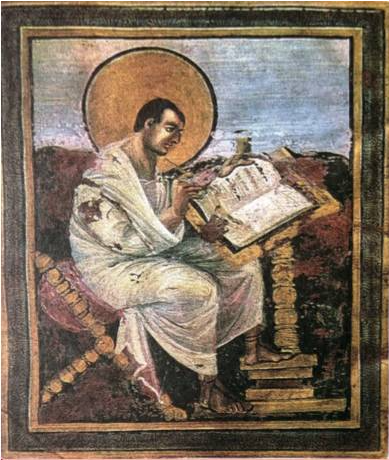
Scholars generally agree that illuminated manuscripts originated between the 4th and 6th centuries in the late Roman Empire. The early Christian Church made a pivotal choice. After Christianity gained legality and eventually became the state religion, there was an urgent need to spread its teachings and unify beliefs. The Church saw the potential in the codex form and began to adorn sacred texts with art.
Early manuscripts were largely produced by monks in European monasteries. Consequently, every monastery established a scriptorium, where monks, filled with piety and reverence for their religion, worked with undivided attention and focused expressions.
The artistic styles of these earliest Christian illuminated manuscripts did not emerge from a void. In places like Egypt, they were deeply influenced by older, pagan artistic traditions. Early artists incorporated symbols such as the Egyptian ankh and interlace patterns into their work, elements that would later become characteristic features of “carpet pages” in Coptic and Byzantine art.
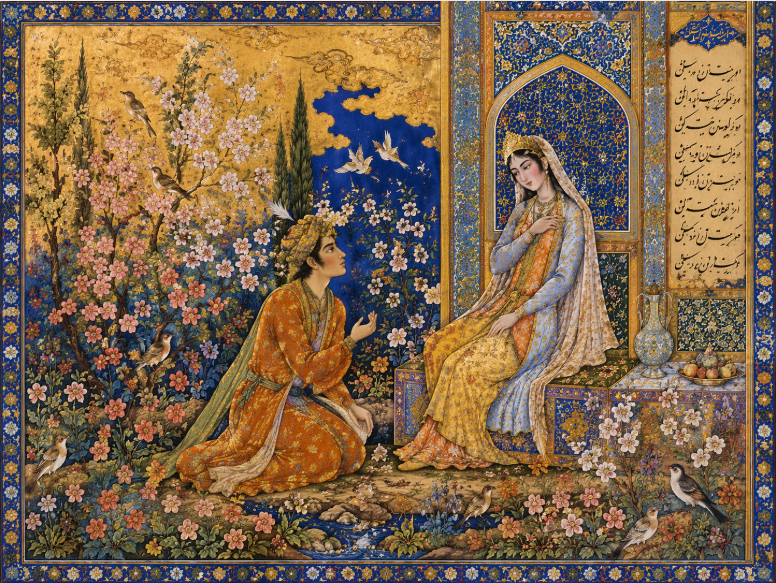
It is also worth noting that the art of the illuminated manuscript boasts a long and rich history in the Islamic world. In Persia (Iran), this art form is known as “Tazhib,” and its origins can be traced back to the Sassanian period.
Western Masterpieces: From the Book of Kells to the Borso d’Este Bible
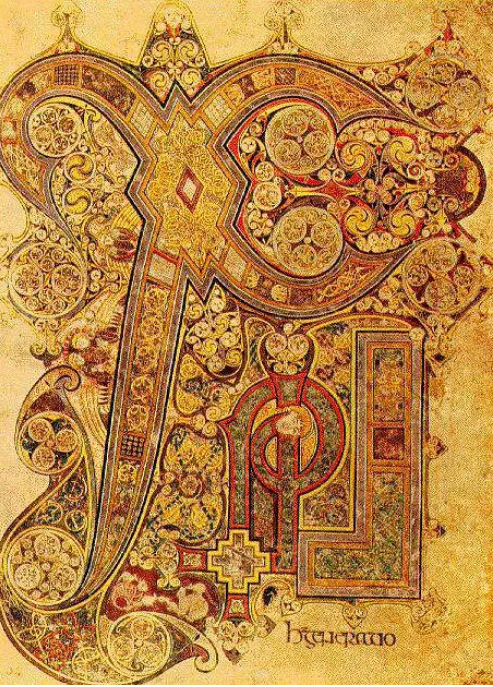
When discussing illuminated manuscripts, one cannot overlook the “Book of Kells,” often hailed as Ireland’s national treasure. Created around the 9th century, this illuminated manuscript represents the pinnacle of Western calligraphy and painting, epitomizing the Hiberno-Saxon style that flourished in Ireland and England from the 7th to the 9th centuries. Its pages are adorned with extraordinarily intricate and ornate decorations, filled with Celtic spirals, interlace patterns, and various fantastical animal motifs, with colors that remain strikingly vivid to this day.
The artistic style of illuminated manuscripts underwent a rich evolution: from early Byzantine art, to the decorative Celtic painting of Ireland and England, to the Carolingian and Ottonian periods, and then to the Gothic style that flourished from the 12th to the 15th centuries. The prayer books created by the Limbourg Brothers in the 15th century mark the zenith of Gothic manuscript art. The Limbourg Brothers were the most renowned illustrators in Europe during the late 14th and early 15th centuries; their manuscript illuminations represent the highest achievement of late Gothic miniature painting. Commissioned by the Duc de Berry, they created 71 illustrations for the Très Riches Heures, with the calendar scenes vividly depicting the interdependence between humanity and nature.
The Purpose of “Illumination”: More Than Mere Beauty
The rise of the illuminated manuscript is inseparable from the widespread dissemination of Christianity. In early medieval Europe, where literacy rates were extremely low, images served as the most intuitive tool for education. The figures and scenes depicting biblical stories were not merely decorative; they were a “Bible for the illiterate,” helping believers understand doctrine and serving a guiding and instructive role.
Simultaneously, this practice stemmed from a profound “veneration of the Word.” In that era steeped in mysticism, people believed that the Word of God held inherent divine power. Adorning the opening letters of chapters with lavish colors, and even with, was precisely intended to sanctify the divine word further and enhance its inspirational power over the faithful. The decoration of chapter initials in manuscripts was not merely for beautification; more importantly, it served as a means to sanctify the words of Jesus Christ, representing God.
Consequently, illuminated manuscripts were immensely valuable in the Middle Ages. A well-crafted Gospel book could require months or even years of labor and the skins of dozens of animals. Such books were time-consuming and labor-intensive to produce, typically commissioned only by royalty, nobility, or the Church, with themes predominantly related to the Christian faith. In medieval Europe, people relied on manuscripts to disseminate knowledge. Books of that era were primarily aimed at spreading Christian culture. To propagate doctrine to the faithful, the Church established numerous academic and artistic centers within monasteries, dedicated to the copying and binding of books, using the precious material of parchment.
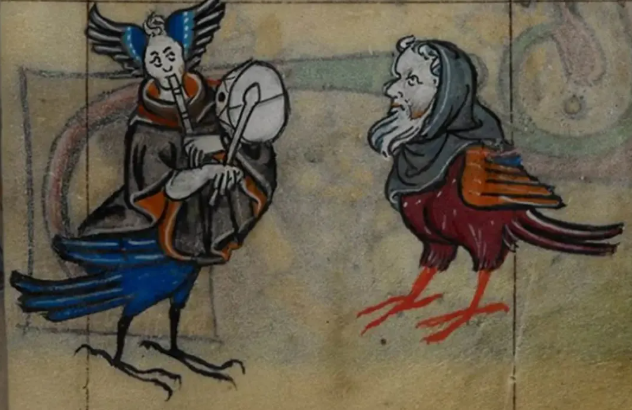
Interestingly, in the margins of many manuscripts, one often finds bizarre and whimsical little illustrations that have little to do with the religious text or the book’s main content. In English, such marginal illustrations are termed “drollery” or “grotesque.” Manuscripts containing these grotesques began to flourish around the 12th and 13th centuries. Some scholars suggest that these irreverent images, appearing on the periphery of sacred verses and prayers, might imply a warning: that once one strays from the truth, the world descends into chaos and corruption.
Masterful Craftsmanship: The Complex Production Process
Creating an illuminated manuscript was a complex and expensive undertaking. It was typically a collaborative effort involving specialized scribes and illustrators working in a monastery’s scriptorium or a dedicated workshop.
The production process generally included the following steps:
Parchment Cutting and Page Layout: The prepared parchment was cut to the appropriate size. Rulers and styluses were used to rule lines on the page to guide the scribe’s writing. Since manuscripts were commissioned books, there was no “standard size”—they ranged from large volumes like the Arsenal Bible at approximately 28.5 × 20.2 cm, to small ones like the Hours of Jeanne d’Évreux, Queen of France, measuring only 9.2 × 6.2 cm.
Text Copying: Scribes began writing using quills or reed pens dipped in ink. After the text was completed, the illustrators began their work. They would first sketch designs on wax tablets backed with heat-resistant and corrosion-resistant metal plates, then transfer the outline onto the parchment. It is important to note that the production process always involved writing the text first, leaving blank spaces for the illustrations to be added later—scribes and illuminators were two distinct groups of professionals with different specializations.
Applying Gold Leaf and Painting: Once the written pages had dried, they were handed over to the illuminators for decoration. Gold leaf was applied before painting. In an era before chemical pigments, people created natural powdered colors from materials found in nature. Cinnabar yielded deep reds, madder root produced pinks, and the most expensive ultramarine blue came from lapis lazuli mined in Afghanistan. Painters would mix these powdered pigments with egg yolk to create tempera paints for coloring.
Binding into Books: After the paint on all pages had dried, they were gathered into quires, typically of 16 to 20 leaves, folded and sewn together with thread. The spine was then reinforced with cords and leather. Book covers came in various forms—wealthy clients might commission covers adorned with precious metals, gems, or ivory, while ordinary manuscripts were bound simply with wooden boards or leather. For example, a German illuminated manuscript from around 1430 features a fine binding of brown leather, a spine with five raised bands, copper clasps, blind-tooled patterns on the front and back covers, and a central coat of arms.
The Twilight of the Manuscript Era
The art of the illuminated manuscript thrived in Europe for over a thousand years. However, in the mid-15th century, Johannes Gutenberg’s invention of the printing press sounded its death knell. Gutenberg, a goldsmith by trade, developed a type-casting device that produced multiple identical pieces of type which could be combined and reused. He also successfully formulated an oil-based ink, enabling the rapid development of printing technology. Machine-produced books were faster and cheaper to manufacture, causing the number of illuminated manuscripts to dwindle drastically, eventually becoming luxuries commissioned only by the wealthiest patrons.
Advanced printing technology spread quickly due to its immense practicality, and books were printed and published in quantities previously unimaginable. It is estimated that before Gutenberg, the number of manuscripts in Europe numbered only in the thousands. By the year 1500, approximately 10 million printed books were in circulation.
Manuscript illumination, as an art form, reached its peak of development in Europe during the early Middle Ages, only to be supplanted by the advent of printing in the 15th century. Among the various art forms encompassed by manuscript illumination, elements such as cover design and interior illustrations were, to varying degrees, inherited and adapted by subsequent printing technology.
Treasures of Today
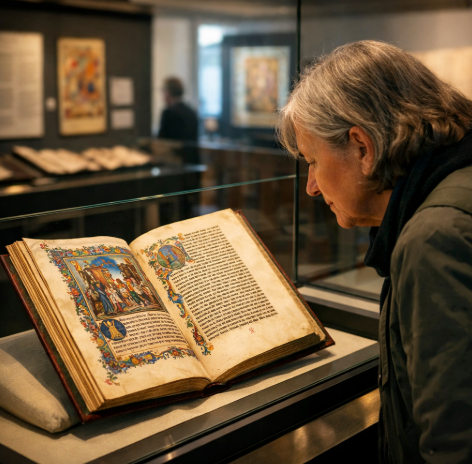
Today, precious illuminated manuscripts are primarily housed in national libraries, museums, and similar institutions, such as the British Library and the National Library of Wales. Many significant manuscripts have been inscribed onto UNESCO’s Memory of the World Register. In 2003, an Ottonian illuminated manuscript received this distinction.
The very journey of these manuscripts through history reveals shifting social tastes and cultural trends. They possess their own biographies, navigating the currents of time as they pass from owner to owner and era to era, rising and falling with the tides of fortune. The finest medieval illuminated manuscripts are cornerstones of Western culture—they have been entangled in politics, revered as objects of sublime beauty, and have even become symbols of nations.
When we stand before display cases in museums today, gazing through the glass at pages whose colors remain vivid after a thousand years, we can still sense the profound devotion with which the people of that age painted, stroke by stroke, the sacred and glorious world they envisioned.
They are more than just books; they are treasures of civilization, preserving faith and crystallizing time.
Related Posts