The Window to Heaven: The Origin of Icons and a Thousand-Year Sacred Journey
Where Colors and Lines Interweave, Composing a Silent Poem of Theology
In the dim light of Eastern churches, sacred faces on golden backgrounds gaze silently upon generations of faithful. These works, known as “icons,” are far more than ordinary art—they are windows to heaven, theology woven in color, and the Gospel proclaimed in silence. Today, let us trace the origins of icons together and explore this artistic path radiant with divine glory.
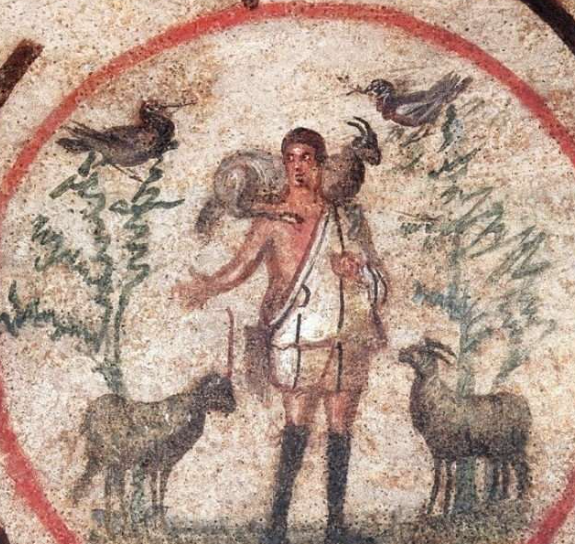
Origins: Symbols of Faith in the Catacombs
The origin of icons can be traced back to the early years of Christianity, a time of persecution. In the 3rd and 4th centuries, Christians in the Roman Empire were forced to gather in secret within underground catacombs. On the walls of those dim passageways, they left the earliest traces of Christian art—not direct depictions of Christ and the saints, but symbolic signs: the fish representing Christ, the anchor symbolizing hope, the ship as a metaphor for the church, the dove signifying peace, and the palm branching triumph.
The word “icon” comes from the Greek “εἰκών” (eikōn), meaning “image.” Interestingly, in Greek, the verb used for creating these icons is not “to paint” but “to write.” This unique linguistic phenomenon reveals a profound theological concept: the iconographer is not composing from artistic imagination but is writing divine revelation, transmitting sacred truth just as one copies the words of Scripture.
A Turning Point: From Symbols to Figures
In 313 AD, Emperor Constantine the Great issued the Edict of Milan, granting Christianity legal status. From then on, Christians could openly express their faith, and Christian art underwent a significant transformation. To convey doctrine to the illiterate populace, the Church began adopting more direct depictions of figures to narrate biblical stories. Artists of this period drew upon the cultural traditions of Greece and Rome and started to create images of Christ, the Virgin Mary, and the saints.
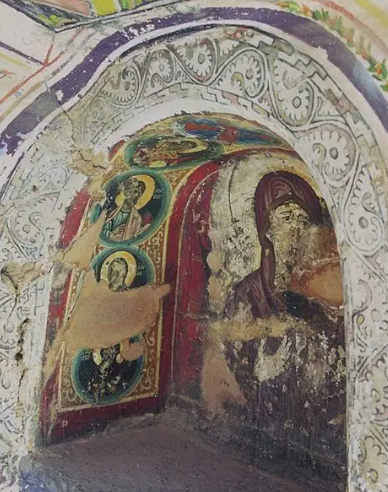
The Byzantine Empire emerged as the center of icon creation. By the 5th and 6th centuries, icons had gradually developed a unique artistic language and theological system. The oldest surviving icons are preserved in St. Catherine’s Monastery at the foot of Mount Sinai in Egypt. These works from the 6th century fortunately escaped the destruction of the later Iconoclastic period, allowing us a glimpse of early iconography today. These ancient icons employed the encaustic technique popular at the time and still retained the realistic characteristics of classical painting in their depiction of figures.
Crisis: The Impact of Iconoclasm
The development of icons was not without challenges. During the 8th and 9th centuries, a fierce controversy over the veneration of icons swept through the entire Eastern Church, a period known as Iconoclasm. This movement occurred in two phases (726–787 and 813–843), with the core question being: Is it permissible to depict sacred figures through artistic means? Does the honor shown to these images equate to idolatry?
In this theological debate, St. John of Damascus played a pivotal role. In three seminal treatises, he distinguished between three different types of images, providing a solid theological foundation for the veneration of icons. He pointed out that “the image of the Savior is indescribable, but the person of Jesus in human form can be depicted.” His arguments became the primary theological basis for the Second Council of Nicaea in 787, which restored the veneration of icons.
In 843, the veneration of icons was definitively restored at the Council of Constantinople. To this day, the Eastern Church celebrates the “Triumph of Orthodoxy” on the first Sunday of Great Lent each year, commemorating the orthodox doctrine represented by icons.
Theology: Windows to Heaven
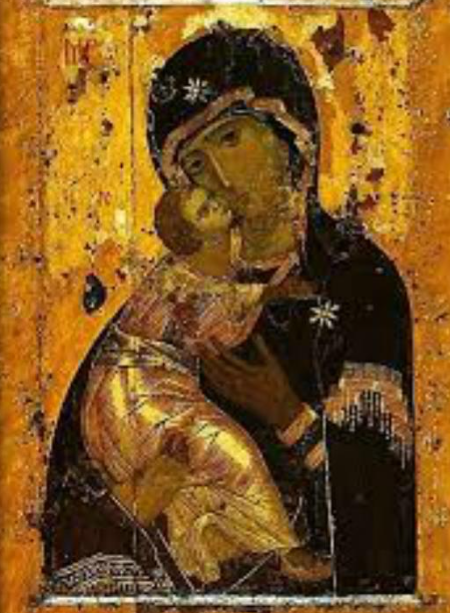
Icons are not ordinary paintings; they possess a unique theological significance and artistic principles. The Eastern Church believes that the purpose of an icon is not to express the transient beauty of this world, but to manifest the eternal beauty and glory of the world to come. Therefore, icons employ two-dimensional space, lacking the perspective developed in the Western Renaissance. This inverse perspective creates a sacred space that transcends nature.
Why do figures in icons have large eyes, small mouths, prominent foreheads, and long, straight noses? These are not artistic shortcomings but profound theological symbols: large eyes signify the awe of seeing God face to face; a prominent forehead indicates being filled with the power and wisdom of the Holy Spirit; a long, straight nose symbolizes the breath of God’s life; the small, closed mouth emphasizes the importance of contemplation and prayer; and the slightly larger ears stress that listening to the Word of God is more important than speaking.
The colors in icons are also rich in symbolism. Blue often represents humanity, red symbolizes divinity, and white alludes to the resurrection. In the icon of Christ Pantocrator, Jesus’ red inner garment signifies his divinity, while his blue outer garment represents the humanity he assumed in the incarnation.
Dissemination: From Byzantium to Russia and Beyond
As the influence of the Byzantine Empire expanded, the tradition of iconography spread to other regions. In 988 AD, the Kievan Rus’ adopted Christianity, and with it came icons, which then merged with local folk art to develop a uniquely Russian school of icon painting.
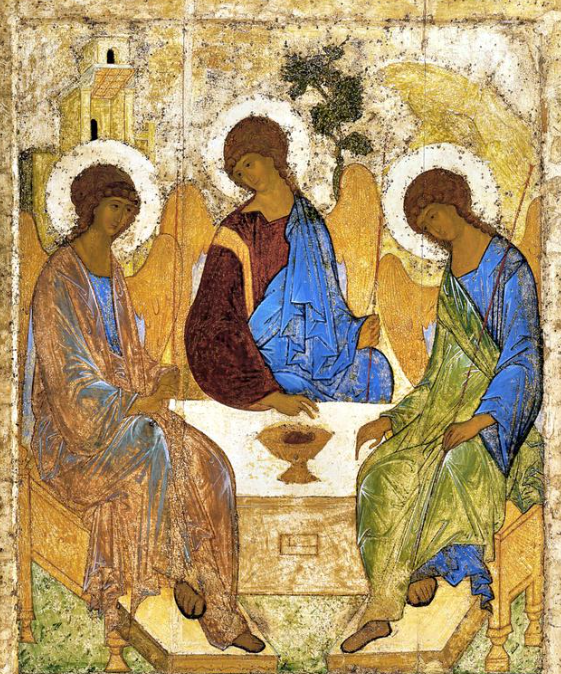
Russian iconography formed three main regional schools: the Southwestern (Kiev), the Northwestern (Novgorod and Pskov), and the Northeastern (Vladimir-Suzdal, Moscow). Andrei Rublev emerged as the most outstanding representative of Russian iconography, with his work The Trinity considered the pinnacle of icon painting.
Beyond Byzantium and Russia, Crete, Romania, Serbia, Syria, the Caucasus region, Egypt, Ethiopia, and even parts of the Catholic world also developed their own distinct traditions of iconography.
Life: Integrated into the Daily Faith of Believers
In the tradition of the Eastern Church, icons are inextricably linked to the life of the faithful. From birth to death, the life journey of an Orthodox Christian is accompanied by icons: a newborn infant is presented before an icon; a bride and groom receive their blessing in the presence of icons during the wedding ceremony; and at a funeral, an icon is placed upon the coffin of the departed.
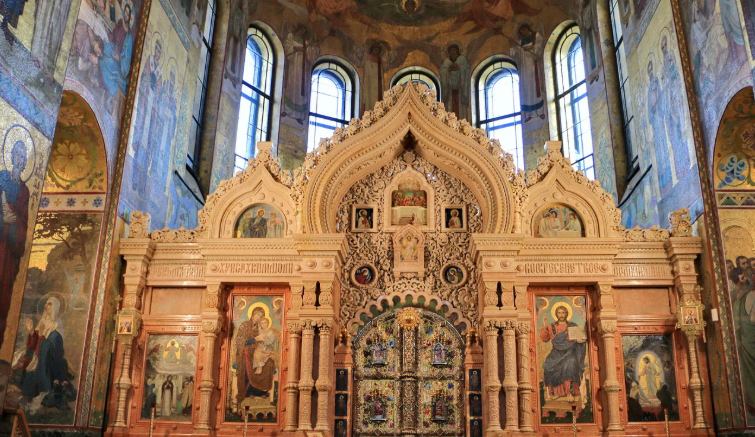
Within the church, icons hold a place of central importance. The iconostasis in an Eastern Rite church separates the sanctuary from the nave, and the icons upon it symbolize the presence and communion of the saints. Flanking the Holy Doors are typically the icons of the Virgin and Child and of Christ Pantocrator, which respectively mark the beginning of salvation (the birth of Christ) and its fulfillment (the Second Coming of Christ).
In the home, Orthodox Christians also hang icons in a prominent place, serving as the focal point for family prayers. These icons, acting as “windows to heaven,” guide the faithful to transcend material reality and enter into the contemplation of the divine mysteries.
Conclusion: The Silent Proclamation of the Gospel
Through a millennium of development, icons have become the “beautiful silent teaching” within the Christian world. They write the faith of the Church with colors and lines, conveying the message of salvation through symbol and meaning. In an age when literacy was not widespread and many could not read, icons served as an textbook for the people to understand the Bible and doctrine. Today, they remain an indispensable companion on the spiritual journey of the faithful.
As one scholar noted: “An icon is not merely religious art; standing before it, simply looking is not enough. The world of the icon is a world of harmony, unity, peace, and stillness. When one prays silently before an icon, one is imperceptibly led into the world of this image.”
In this era saturated with images, icons, with their unique transcendence and sacredness, continue to show the world another possibility of “seeing”—not chasing after fleeting visual outward, but gazing inward upon eternal spiritual reality. Every icon is an open window, inviting us to catch a glimpse of the glory of heaven.
The next time you stand before an ancient icon, try to slow your pace. Allow that golden light and those solemn countenances to lead you into deeper contemplation and prayer.
Related Posts