In recent years, as Chinese antique ceramics have continued to attract attention in the international…
White Gold: Meissen Porcelain, a Three-Hundred-Year History of Power and Art in Europe
On the tranquil banks of the Elbe River in eastern Germany lies the small town of Meissen. Here, there are no bustling assembly lines, but rather the deep, unchanging hum of the potter’s wheel, a sound unchanged for three centuries. The artisans’ brushes fall precisely on the pristine white porcelain, painting the iconic pair of blue crossed swords.
This is more than just a trademark. It is the ambition of an empire, an industrial espionage operation spanning half a century, and an artistic declaration of Europe’s journey from Oriental fascination to self-awakening. Today, let us push open the doors of the Meissen porcelain kingdom and touch this history forged into “white gold.”
Chapter 1 The King’s Prisoner, and a Stolen Dream
The story begins with an obsessed monarch—Elector Augustus II of Saxony, better known by his nickname “The Mighty King.” His fervor for Chinese porcelain reached an unbelievable level: he once traded an entire corps of dragoons with the King of Prussia for 127 Chinese blue-and-white porcelain vases. These objects from the distant East, lustrous as jade and resonant as chimes, were known in Europe as “white gold,” their formula seemingly flawless, like something out of a myth.
The king turned his desire into national action. He “invited” a young alchemist named Johann Friedrich Berthes into the castle, effectively placing him under house arrest, and gave him only one command: to turn lead into gold—no, to turn clay into porcelain.
With the assistance of the scientist Chienhaus, and after tens of thousands of experiments, on a cold winter night, January 15, 1708, the first true hard-paste white porcelain in European history was born. It was no longer a pale imitation of Chinese porcelain, but a breakthrough achieved through chemical and physical processes. Two years later, in 1710, Europe’s first porcelain workshop was established at Albrecht Castle in Meissen. This marked the beginning of the European porcelain industry.
Chapter Two: Drawing the Swords: From Imitating the East to Defining Europe
The nascent Meissen was a shadow of the East. It imitated the landscapes of Chinese blue and white porcelain and the painted designs of Japanese Kakiemon. However, great imitation will eventually give birth to even greater creations.
In 1720, the arrival of a genius changed the course of events. Painter Johann Gregorius Herold invented an unprecedentedly rich array of overglaze pigments, allowing porcelain to be adorned with the vibrant colors of European oil paintings. Following this, sculptor Johann Joachim Candler infused the clay with the exuberant vitality of Baroque and Rococo art. The porcelain sculptures under his hands are no longer static decorations: noblewomen’s skirts flutter, musicians are vividly portrayed, and birds and beasts are full of dramatic tension.
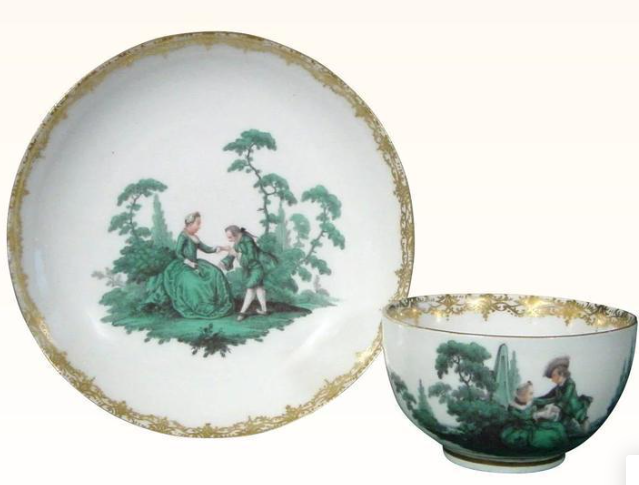
Thus, we witnessed that great “rebellion.”
Maison stopped replicating the orchids and landscapes of China, instead depicting European castles and rural life; it abandoned the Eastern cloud and dragon motif, creating its own mythology—the blue onion pattern (actually based on peaches and pomegranates). The most famous “Minglong” series, with its flamboyant and domineering three-clawed red dragon, while inspired by the East, possessed a dynamic tension and luxurious gold finish that embodied the quintessential European Baroque spirit.
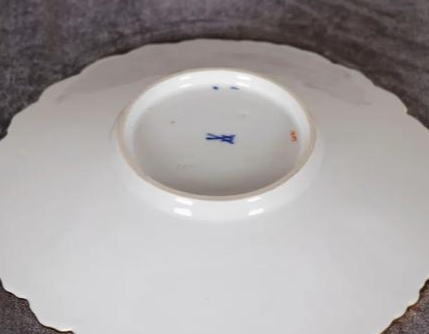
In 1730, the famous pair of blue crossed swords were officially adopted as the trademark. It was like a declaration: We are no longer anyone’s student. We are the standard setters.
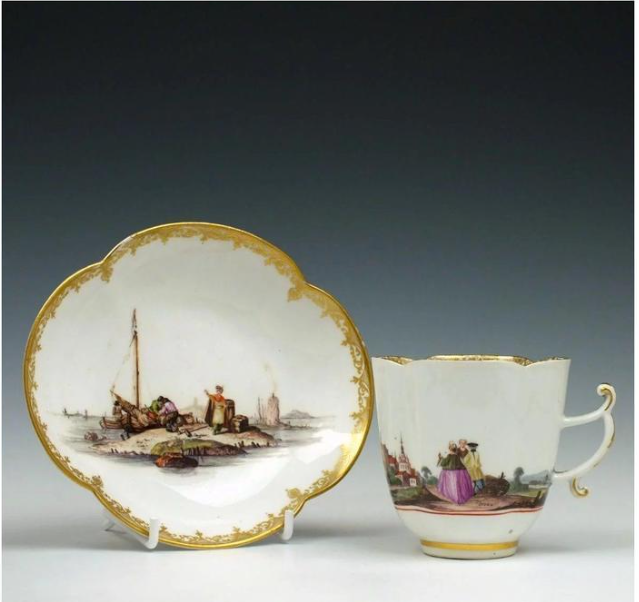
Chapter Three: The Power of White Gold: How It Shaped a Continent
Messenger’s success immediately became a contradictory combination of “state secret” and “fashion benchmark.”
On the one hand, it was tightly protected. The workshops were like military restricted areas; leaking the formula was a serious crime of treason. On the other hand, its allure could not be contained. Royal families and nobles throughout Europe went crazy for it, and orders poured in. A single piece of Meissen porcelain cost as much as its weight in gold.
The more profound impact was that it ignited a ceramic revival throughout Europe. Craftsmen and apprentices quietly took the techniques and aesthetics with them, like sowing seeds of revolution: Vienna (1718), Venice (1720), Sèvres, France (1740)… almost all of Europe’s major porcelain kilns originated directly or indirectly from Meissen. It can be said that Meissen laid the foundation for the modern European ceramic industry.
It evolved from a luxury item into a hard currency for the circulation of power, a state gift for diplomatic occasions, and even a vehicle for artistic thought. Napoleon and Catherine II were among its admirers. Among countless still-life paintings and court portraits, displaying a piece of Meissen porcelain is the ultimate symbol of its owner’s wealth and taste.
Epilogue: The Sound of Swords Across Time
Today, stepping into the Meissen workshop, time seems to stand still. Here, approximately 700 artisans still employ the division of labor and cooperation methods used 300 years ago. From preparing the clay, shaping, painting to firing, every step relies on the tacit understanding of human hands and experience. The factory preserves over 800,000 original molds, meaning that any classic 18th-century piece can be precisely replicated.
But this is far from simple conservatism. Those two blue swords guard a belief: true luxury is not the accumulation of materials, but the condensation of time, knowledge, and human focus. In the age of mechanical reproduction, Meissen stubbornly proves the irreplaceable nature of handcraftsmanship—the subtle tremor of each stroke, the unique feel of each relief, are souls that machines cannot impart.
Therefore, the next time you see those two blue swords, it will no longer be merely a mark of a fine porcelain piece. It is the starting point of a legend, an artistic dialogue spanning East and West, and a modern European history forged in the crucible of high temperatures.
It reminds us that the combination of the most fervent desire (the king’s obsession with porcelain) and the most discerning science (Bertger’s experiments) can create such timeless beauty. And this is the true secret behind Meissen porcelain’s enduring brilliance across three centuries.
Related Posts