
In recent years, as Chinese antique ceramics have continued to attract attention in the international…
Treasures Spanning a Millennium: Imprints of Civilization in Three Ancient Artifacts
The significance of collection lies not only in owning an object, but more importantly in touching the warmth of civilizations from a thousand years ago through it. The three artifacts to be shared with you today all date back to ancient times, spanning the Han, Tang, and Song dynasties. Though they belong to different categories, each carries the ingenuity of ancient craftsmen and the marks of its era, allowing us to seek out those frozen moments of civilization in the long river of time.
I. Gilt-Bronze Belt Hook of the Han Dynasty: A “Golden-Jade Union” in Miniature
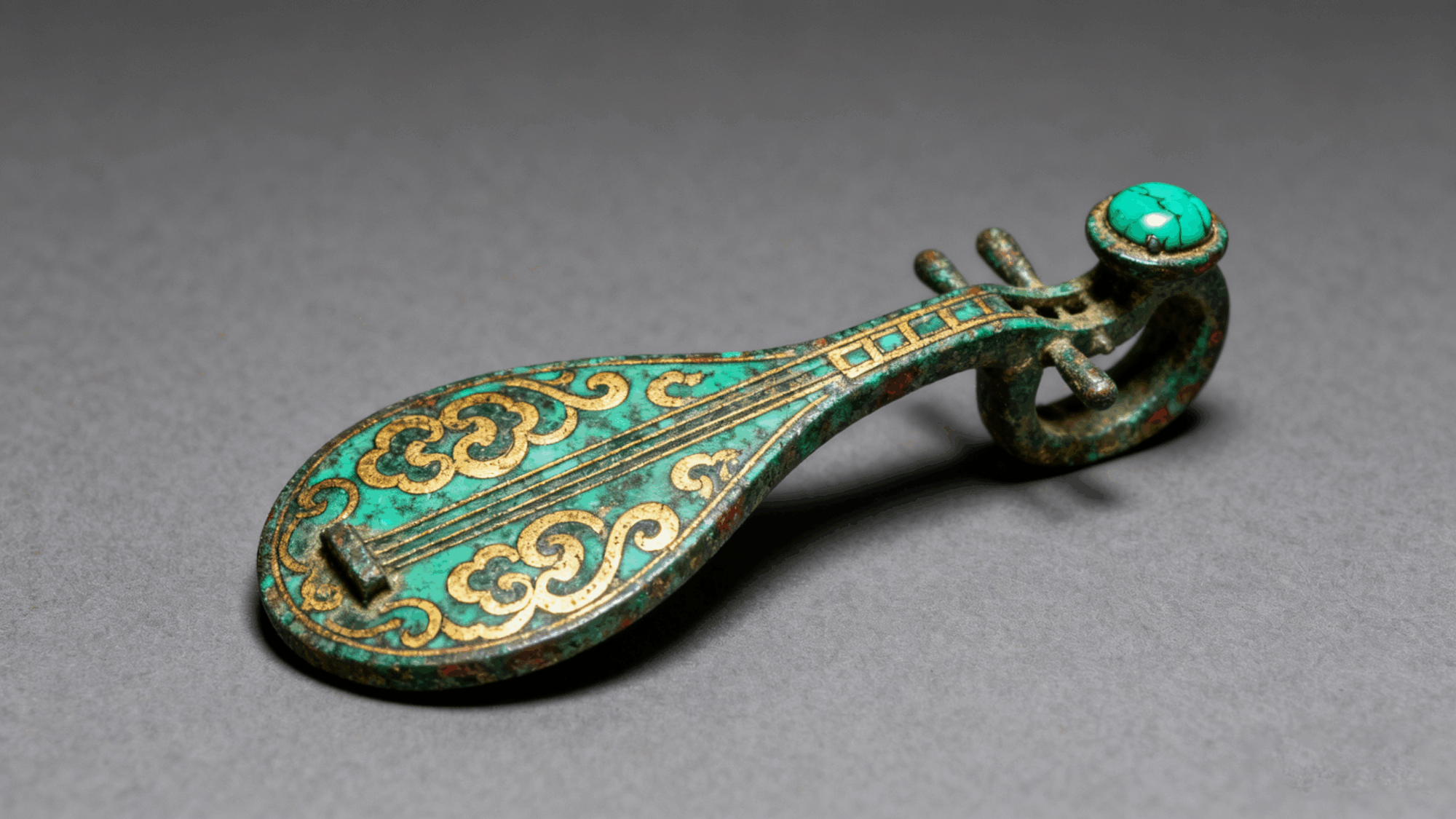
The first artifact is a gilt-bronze belt hook from the Han Dynasty. Approximately 12 centimeters in length, it takes on an overall pipa (Chinese lute)-like shape. After two thousand years, the bronze surface has developed a warm, bluish-green patina, yet its original exquisite craftsmanship remains discernible. Though small in size, the belt hook was an indispensable accessory for the noble attire of the Han Dynasty. Used to fasten waist belts, it functioned similarly to a modern belt buckle, but its craftsmanship far surpassed that of ordinary practical objects.
The most stunning feature of this belt hook lies in its gold inlay technique (cuò jīn in Chinese). Craftsmen first carved fine grooves into the bronze base, then embedded gold wires into these grooves, and finally repeatedly hammered and polished the surface with tools to ensure the gold wires fused perfectly with the bronze, forming smooth patterns. The pattern on the front of the belt hook is a typical “cloud pattern” of the Han Dynasty—with winding, flexible lines that curl like floating clouds. Against the backdrop of the bluish-green bronze, the gold wires still shimmer with a soft luster even after a millennium, as if freezing the brilliant radiance of the Han Dynasty within.
What makes it even more interesting is that a small piece of turquoise is inlaid at the end of the belt hook. Though partially worn, its original color is still visible. Turquoise was a precious gemstone in the Han Dynasty, often paired with gold and silver to symbolize nobility and auspiciousness. This gilt-bronze belt hook skillfully combines three materials—bronze, gold, and turquoise—not only demonstrating the superb metalworking skills of Han Dynasty craftsmen, but also reflecting the noble class’s pursuit of perfection in clothing accessories at that time.
Regarding the origin of this belt hook, according to the collector, it was accidentally discovered many years ago near the tomb of a Han Dynasty noble in Luoyang, Henan Province. Although there is no explicit written record of its owner’s identity, judging from its craftsmanship and materials, the owner was most likely a prince, noble, or high-ranking official of the Han Dynasty. Today, this belt hook is not only a collectible, but also an important physical artifact for studying the clothing culture and metalworking techniques of the Han Dynasty.
II. Tri-Color Glazed Camel Figurine of the Tang Dynasty: Prosperity of the Silk Road in Glazes
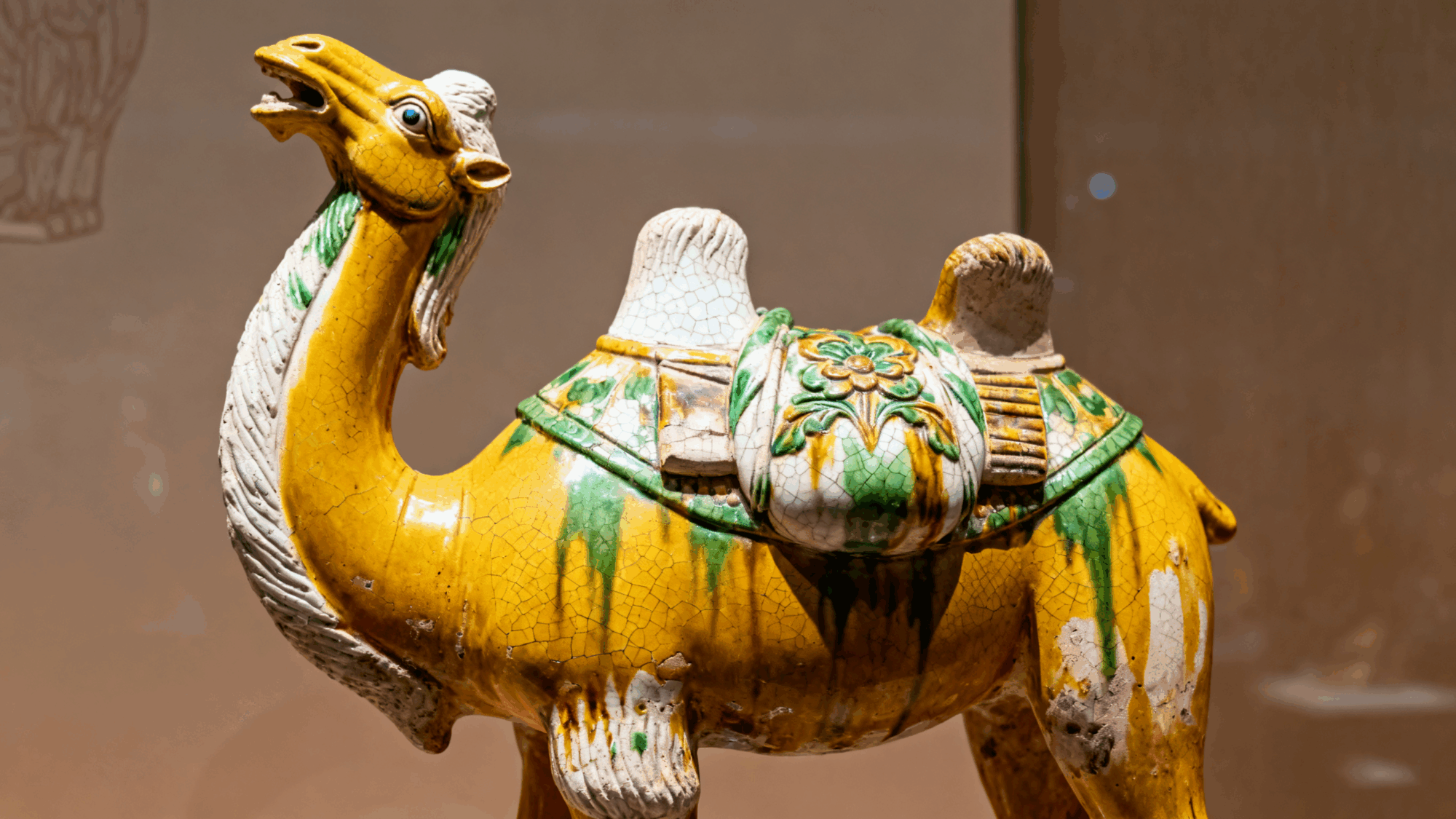
If the Han Dynasty belt hook embodies exquisite life aesthetics, this tri-color glazed camel figurine from the Tang Dynasty carries the lofty spirit of the Silk Road during the golden age of the Tang Empire. Standing approximately 50 centimeters tall and 40 centimeters long, the camel stands with its head held high, its four limbs sturdy and powerful. On its back, it carries a small “cargo pouch” decorated with simple patterns, vividly recreating the scene of camels transporting goods along the Silk Road in ancient times.
Tang Dynasty tri-color glazed pottery (sancai) is primarily characterized by three glaze colors: yellow, green, and white—and this camel figurine is no exception. The camel’s body is mainly covered in yellow glaze, which is evenly applied and rich in color. The surface also features fine crackles, a unique natural mark formed over a thousand years and one of the important bases for authenticating Tang sancai. The camel’s neck and back are accented with green and white glazes: the green glaze is rich and bright, while the white glaze is pure and mellow. The three glazes blend with each other yet remain distinct in layers, as if condensing the vibrant colors of the Tang Dynasty into this single figurine.
A closer look reveals that the camel’s head is exquisitely detailed: its eyes, painted with black glaze, are bright and piercing; its mouth curves slightly upward, as if carrying a trace of weariness yet brimming with perseverance—this is a true portrayal of the camels that traversed the Silk Road. The Tang Dynasty was the heyday of the Silk Road, and camels, as the main means of transportation, bore the weight of commodity and cultural exchanges between the East and the West. This tri-color glazed camel figurine is not only a representative work of Tang Dynasty ceramic craftsmanship, but also a vivid testament to the cultural integration along the Silk Road.
The collector of this camel figurine is an enthusiast of Silk Road culture. To acquire this artifact, he traveled to many places and finally purchased it from an elderly collector. The collector said that every time he looks at this camel figurine, he can imagine the ancient caravans leading camels across deserts and Gobi, transporting Chinese silk and porcelain to the West, and bringing back Western spices and jewelry to China. That kind of prosperity and lofty spirit that transcended mountains and seas is unforgettable.
III. Sky-Blue Glazed Plate of the Ru Kiln (Song Dynasty): Millennium Elegance in Porcelain
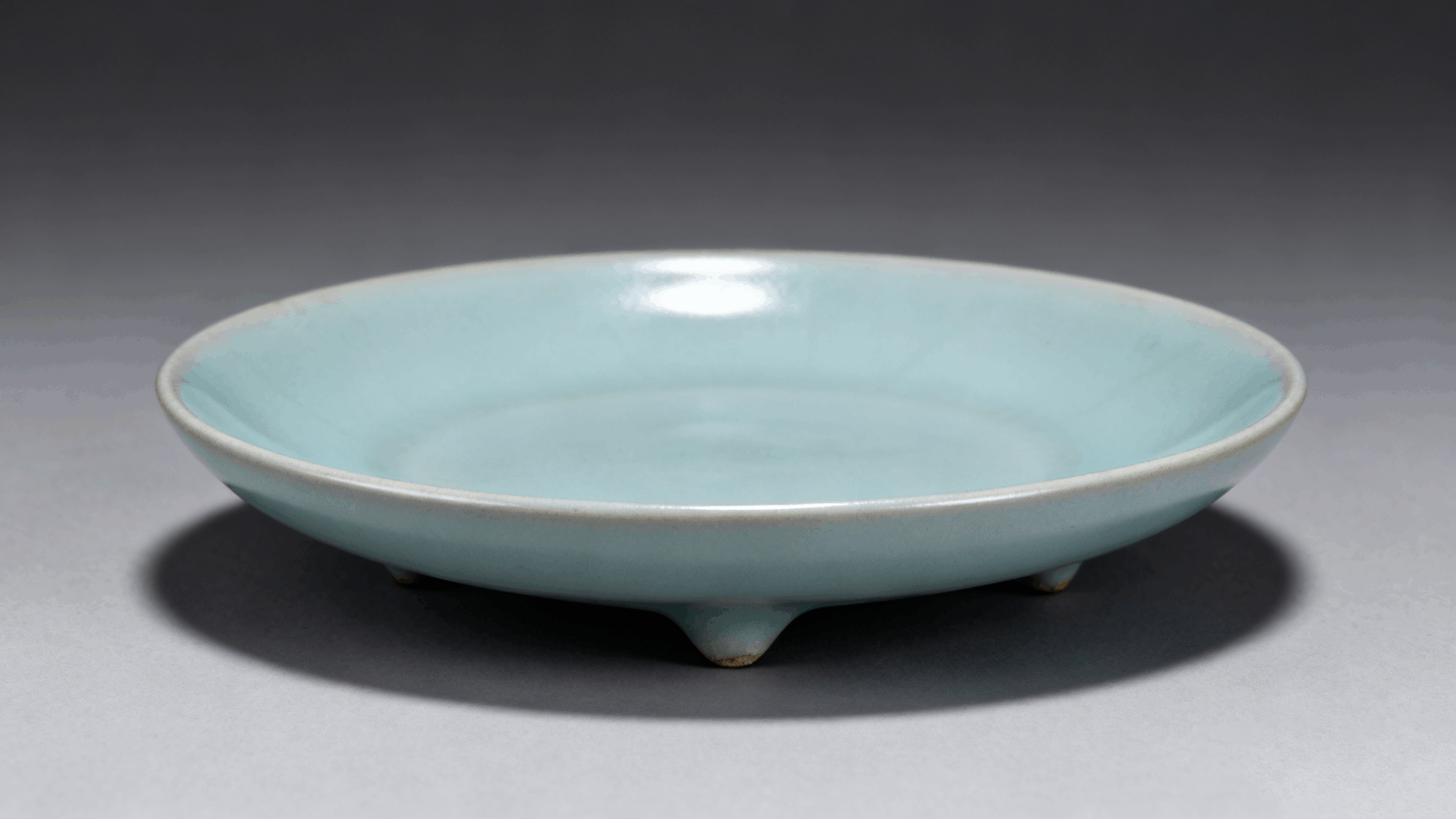
When it comes to Song Dynasty porcelain, the “Five Great Kilns”—Ru, Guan, Ge, Jun, and Ding—are known to all. Among them, the Ru Kiln, renowned for its “sky-blue glaze” and “golden and iron wires” (fine crackles), is praised as the “top of the Five Great Kilns.” The number of existing intact Ru Kiln artifacts is extremely rare—fewer than a hundred worldwide. Therefore, this sky-blue glazed plate from the Song Dynasty Ru Kiln can be called a “rare treasure” in the collection world.
With a diameter of approximately 15 centimeters, this Ru Kiln plate is entirely covered in a “sky-blue” glaze—the most representative glaze color of the Ru Kiln. It resembles the sky after a rain shower: warm, elegant, and free from any gaudiness. The glaze surface is fine and smooth, as gentle and smooth as jade; when touched lightly with a hand, one can feel its lustrous and smooth texture. There are three small “support nail marks” on the bottom of the plate—a unique firing technique of the Song Dynasty Ru Kiln. During the firing process, craftsmen used small support nails to prop up the porcelain, preventing direct contact between the porcelain and the kiln tools, thus ensuring the glaze surface remains intact and even. These three support nail marks are small and neat, fully demonstrating the rigor and meticulousness of Song Dynasty craftsmen.
The value of Ru Kiln porcelain lies not only in its glaze color and craftsmanship, but more importantly in its cultural connotation. The Song Dynasty was a golden age for Chinese cultural development, with the rise of the literati class. They pursued an aesthetic of “simplicity, elegance, and restraint,” and Ru Kiln porcelain perfectly aligned with this aesthetic pursuit. The sky-blue glaze surface, without excessive decoration, fully embodies the beauty of simplicity and elegance, as if integrating the grace and poetry of Song Dynasty literati into the porcelain.
The inheritance of this sky-blue glazed Ru Kiln plate was quite tortuous. It was kept among the people for a long time and was not discovered and authenticated as an authentic Song Dynasty Ru Kiln artifact by experts until recent years. Today, the collector preserves it carefully and rarely displays it publicly, only to ensure that this millennium-old elegance endures.
The Art of Collecting Ancient Artifacts: More Than “Possession,” It’s About “Understanding”
Collecting ancient artifacts is different from collecting modern or contemporary ones. It requires collectors to possess profound historical knowledge and artifact authentication skills, and more importantly, a sense of awe for ancient civilizations. From these three artifacts, we can summarize several key points for collecting ancient artifacts:
First is craftsmanship identification. The craftsmanship of ancient artifacts bears distinct characteristics of their era—such as the gold inlay technique of the Han Dynasty, the tri-color glazing of the Tang Dynasty, and the sky-blue glaze of the Song Dynasty Ru Kiln. These are important bases for judging the age and authenticity of artifacts. Collectors need to conduct in-depth research on the craftsmanship characteristics of different eras, and through comparison and analysis, accurately judge the craftsmanship level and chronological attributes of the artifacts.
Second is historical context tracing. Ancient artifacts are often associated with specific historical backgrounds and cultural events—for example, the tri-color glazed camel figurine with the Silk Road, and the Ru Kiln plate with the literati culture of the Song Dynasty. Understanding the history behind an artifact not only enables collectors to gain a deeper understanding of its value, but also provides more clues for artifact authentication.
Third is cultural inheritance. Collecting ancient artifacts is not merely for personal preference or investment; more importantly, it is about inheriting ancient civilizations. Every ancient artifact is a testament to a period of history and a carrier of ancient culture. Collectors have the responsibility to properly protect these artifacts and, through appropriate means, allow more people to understand and appreciate the charm of ancient civilizations.
Though these three ancient artifacts have gone through a millennium, they still allow us to feel the ingenuity of ancient craftsmen, the prosperity of bygone eras, and the elegance of ancient culture. They are gifts from time and imprints of civilization. The process of collecting them is a process of dialogue with civilizations from a thousand years ago—and this is perhaps the most touching charm of ancient artifacts.
Related Posts
In the world of Eastern jewelry, jadeite is more than just a beautiful stone; it's…
In the world of antiques, many collectors eventually face the same question: Should a piece…