A Transcendent Image by Leonardo da Vinci In the history of Western art, few images…
Collectibles Imprinted with the Marks of Time
While sorting through old items, I found an old brass plane in my grandfather’s toolbox—its wooden handle had been polished to a shine from years of use, and the brass blade still bore fine, tiny marks left by work. Engraved on its side with a chisel were the characters “1953”. My father told me this was my grandfather’s “first tool” when he learned carpentry as a young man; it had accompanied him in making marriage beds and wardrobes, and every piece of wooden furniture in our home bore the traces of this plane. This old plane, which wasn’t even an “antique”, suddenly made me understand: collectibles with a sense of time are never cold exhibits in display cases, but “witnesses to time” that carry the warmth of years and can tell specific stories.
Every collectible with a sense of time is engraved with a “life code” unique to its era. On the bookshelf of my neighbor Aunt Zhang, there is a whole row of “picture-story books” from the 1970s and 1980s: Journey to the West, Little Soldier Zhang Ga, and Railway Guerrillas. Though the colors on their covers have faded, the characters in the illustrations remain vivid. She said these picture-story books were her “treasures” when she was a child. Back then, each cost just a few cents; she would save up her pocket money to rush to the Xinhua Bookstore, and after school, she could spend an entire afternoon poring over one picture-story book while leaning over her desk. Now, when she opens these small booklets again, a faint scent of ink still lingers between the pages. On the title page, the name “Zhang Xiaohong” written in pencil has crooked strokes, yet it holds the purest joy of childhood. These old items marked with personal memories are more vivid than any historical record—they document the daily lives of ordinary people and hold the little details of life in an era: the textbooks, toys, and ways of entertainment from that time all gradually emerge along the “grain” of these collectibles.
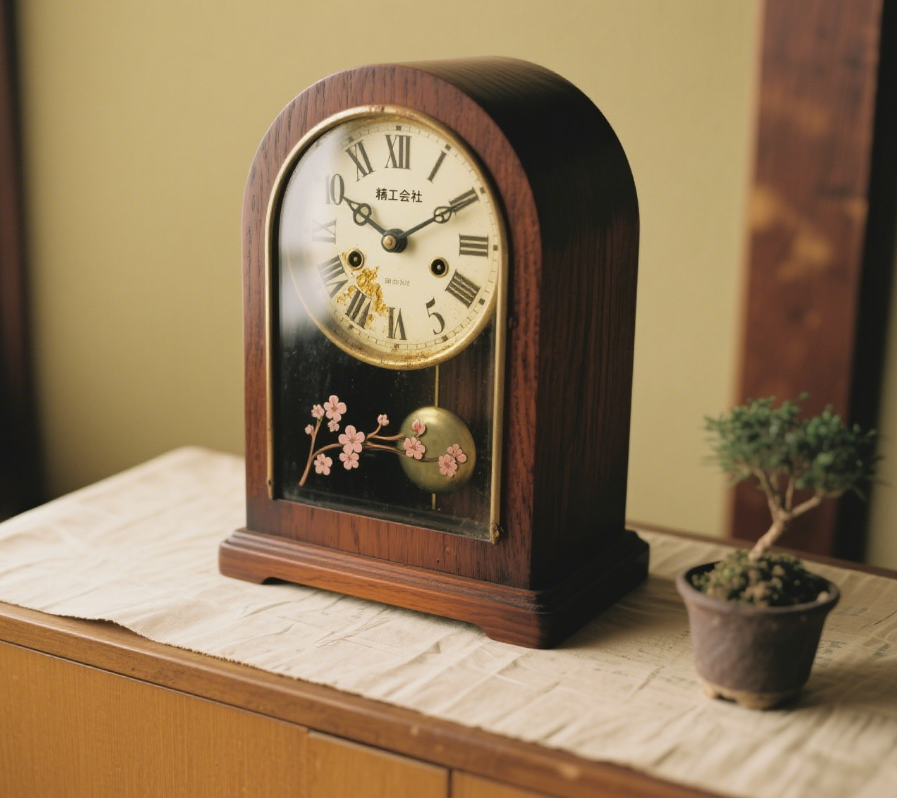
What makes time-honored collectibles most touching is the “warmth in their traces of use”. I know a gentleman who collects old clocks and watches; his home is filled with dozens of table clocks and wall clocks from different eras: there is a “Sanwu Brand” table clock from the Republic of China period, whose pendulum still makes a clear “tick-tock” sound when it swings; a 1950s “Beijixing (Polaris)” wall clock, whose numbers on the dial have become somewhat blurry; and a 1970s alarm clock, whose bell hammer still has a piece of cloth wrapped around it—used back then to adjust the volume. He said he collects old clocks not because they are valuable, but because he loves studying the “traces of use” on them: some clocks have yellowed repair labels stuck on their backs, recording “Repaired at East Street Watch Shop in 1982”; some pendulums have small names carved on them, marks made by their former owners to prevent loss; and some clock faces have tiny scratches, said to be left by children doodling with pencils. These traces are not “flaws”, but the “life resumes” of the collectibles—they once stood in the living room of a family, greeting the morning sun with their owners; they once sat beside a student’s desk, reminding them of school time; and they once rested by an elderly person’s bedside, accompanying them through countless nights.
Collecting time-honored items is also a way of “retrieving forgotten memories of an era”. Last year at a flea market, I found an enamel washbasin printed with the slogan “Learn from Dazhai in Agriculture”. There was a small dent on its rim, and a patch of paint had chipped off the pattern on its bottom. After checking materials at home, I learned that this type of washbasin was a “popular style” in the 1960s and 1970s—almost every household had one. Some used it to wash their faces, some to store grain, and some even used it as a “bath tub” for children. Later, when I posted a photo of the washbasin online, many netizens left comments: “My family used to have one too—my mom still can’t bear to throw it away!” “Seeing this basin reminds me of the days when I used to catch rainwater with it in the yard as a kid.” It turns out that a small old item can evoke shared memories among a group of people—it is like a key that unlocks the collective memories of a generation, memories of childhood, family, and the era itself, making those fading days become clear and warm again.
Nowadays, many people pursue “newness and trendiness”, thinking old items are “outdated” or “useless”. But only those who have truly come into contact with time-honored collectibles understand that their value lies never in “being new or old”, but in “the stories they hold”: an old plane carries the craftsmanship spirit of a grandfather; a picture-story book holds the childhood of Aunt Zhang; an old clock records the daily life of a family; and an enamel basin bears the shared memories of a generation. These collectibles imprinted with the marks of time are like “time capsules”, carefully preserving those precious, vivid, and life-filled moments—allowing us, in this fast-paced present, to look back and see what the past was like.
It turns out that collecting time-honored items is never about “nostalgia”; it is about passing down those memorable stories of time well—letting the next generation know what kind of times our parents and grandparents lived in, and ensuring that those ordinary yet precious days are never completely forgotten by time.
Related Posts