In recent years, as Chinese antique ceramics have continued to attract attention in the international…
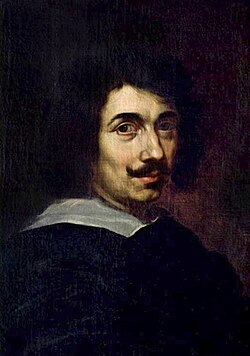
Claude Lorrain: Alchemist of Light, Eternal Architect of the Ideal Landscape
He not only painted light, but also imbued it with temperature, humidity, and time, transforming the ordinary landscape of the Roman countryside into an eternal golden age.
In 1630, a French painter in Rome received a special commission: the nephew of Pope Urban VIII wanted a landscape painting, but stipulated that “the landscape must have historical weight.” The 30-year-old painter did not choose a traditional biblical scene, but instead depicted Aeneas arriving at the coast of Latium—yet remarkably, the viewer’s gaze does not linger on the mythical hero, but is completely captivated by the ideal bay bathed in golden morning light.
This painter was Claude Lorrain. He accomplished a seemingly impossible task: making the landscape itself the protagonist, light the narrator, and traditional historical figures relegated to embellishment. This painting, *Aeneas at Delos*, marks the birth of a new art—the ideal landscape—and will define Europe’s visual perception of “beauty” for the next three centuries.
1. The Roman Journey of a Pastry Apprentice
Claude was not Roman, but he made the landscape of Rome a dream for all of Europe. Born in 1600 in a small village in the Duchy of Lorraine, France, his original name was Claude Gérard. Orphaned at the age of 12, he followed his brother, a pastry maker, to Rome, the art capital—a decision that changed his life and the history of European art.
In Rome, he initially worked as an assistant to the painter Agostino Tassi, his tasks including grinding pigments, preparing canvases, and, most importantly, painting background landscapes. It was this seemingly humble job that allowed him to master the magic of light. “He often set out before dawn,” a contemporary records, “and stayed on the Campanian plains around Rome until dusk, just to observe how light changed everything.”
In 1627, at the age of 27, Lorard completed his first signed work, *Landscape with Cattle*. The painting already revealed his future direction: the horizon was low, allowing the sky to occupy two-thirds of the canvas, and light slowly emerged from the depths. More importantly, he began to establish his own working method: drawing numerous sketches outdoors, recording the light and atmosphere of specific moments, and then recombining these elements in his studio to create a world “more real than reality.”
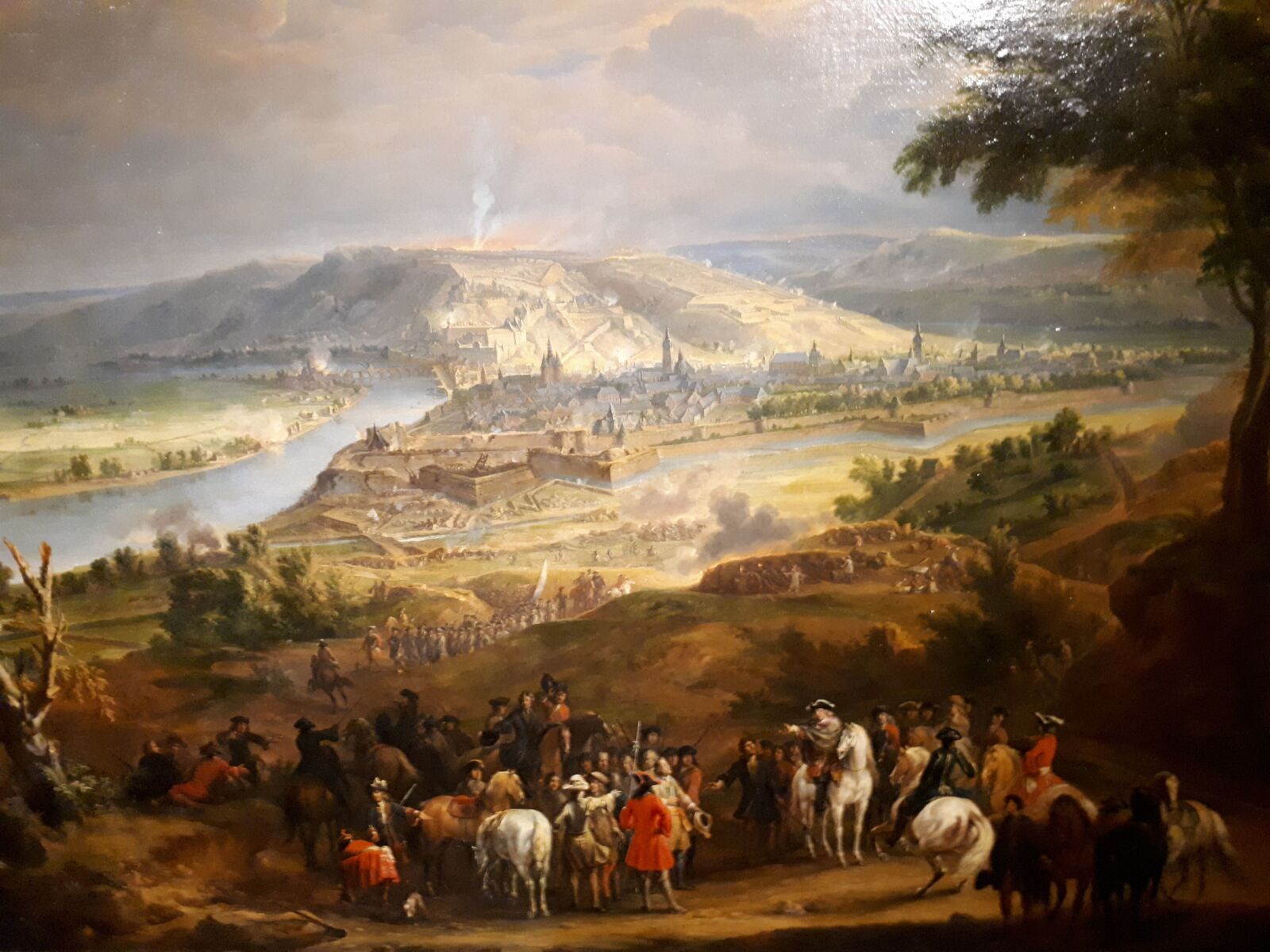
Lorrain’s early work, *Landscape with Cattle*, already reveals his focus on the effects of light and atmosphere.
2. *The Book of Genuine Works*: The Artist’s Self-Definition
In 1635, Lorrain began a unique undertaking in art history: systematically recording each of his works. He created a sketchbook known as *The Book of Genuine Works*, sketching each completed painting in brown ink, with detailed notes on the back including the buyer, subject, date, and price.
“I do this,” he explained in a letter, “both to prevent forgery and to ward off oblivion.” In the 17th-century Roman art market, French painters needed to constantly prove their worth. Lorrain’s *Book of Genuine Works* was not merely an account book, but a project of self-canonization for the artist.
This book allows us to precisely trace the development of Lorrain’s style. In the 1630s, his works, such as *Landscape with Dancing Peasants*, still showed the influence of the Flemish school; by the 1640s, he had developed his signature “Claudeian composition”: the foreground typically featured a “curtain” of dark trees, the middle ground an open expanse of water or plains, and the background mountains or buildings bathed in golden light.
03 The Physics and Poetics of Light
What makes Lorrain’s light so special? While contemporary painters also painted light, only Lorrain captured the “visible air.” In *Landscape with Apollo and the Muses*, the twilight light filters through the trees, forming beams that are almost tangible; in *The Queen of Sheba Boarding the Ship*, the morning light reflected on the sea is so precise that oceanographers can determine the exact time of day depicted.
Lorrain’s secret lies in the masterful use of layering techniques. He would layer transparent, cool-toned glazes over warm-colored underpaintings, sometimes up to a dozen layers. Each layer is extremely thin, allowing the colors beneath to subtly show through, creating the effect of light scattering in the air. He used “aerial perspective”—where distant objects appear cooler in color and have more blurred outlines—to express the thickness of the atmosphere.
“Looking at Lorrain’s paintings,” an 18th-century British collector exclaimed, “you can feel the coolness of the morning or the warmth of the afternoon sun. He paints not just light, but also the temperature of light, the humidity of light, and the duration of light.”
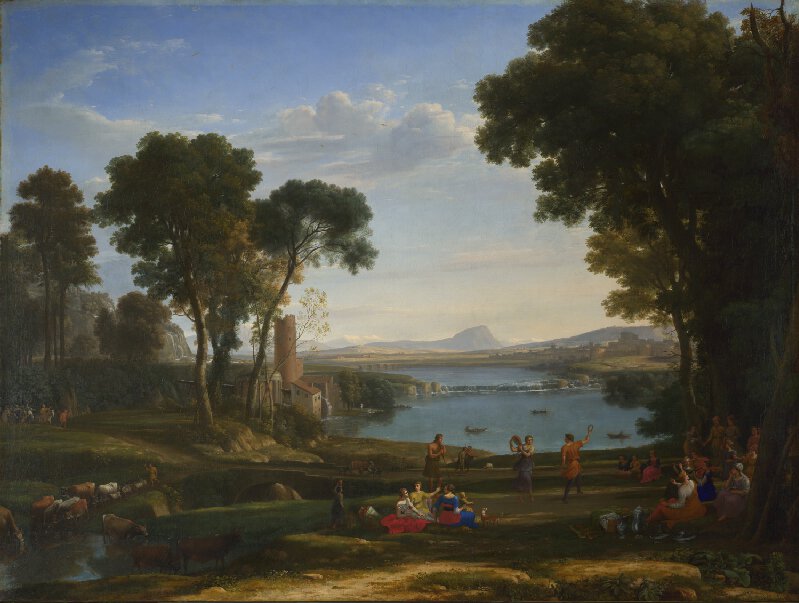
*The Wedding of Isaac and Rebekah* (1648), a masterpiece of Lorrain’s handling of light, everything is bathed in a poetic golden light at dawn.
4. The Golden Recipe for the Ideal Landscape
Lorrain’s great creation is the “ideal landscape”—a landscape both based on realistic observation and poetically refined. His paintings are never simple copies of a specific location, but rather a combination of the essence of multiple locations.
His compositions follow strict mathematical proportions, yet appear completely natural. A typical “Claudeian landscape” includes: dark foliage on the left (often dark green oak or pine trees), forming a natural frame; water in the middle ground (rivers, lakes, or harbors), guiding the eye into the distance; classical architectural ruins in the distance (temples, palaces, or triumphal arches), bathed in golden light; the sky occupying one-third to one-half of the picture, the shapes of the clouds echoing the ground scenery.
Figures in the painting are usually small, playing mythological or biblical roles, but their function is embellishment rather than the main subject. In *Landscape with Shepherd and Flock*, the shepherd may be a character from Virgil’s *Eclogues*; *Landscape with Apollo Watching Admetus’s Flock* comes from Greek mythology. Lorrain skillfully balances landscape and narrative, allowing both to complement each other.
05 The Visual Bible of the British Aristocracy
Lorrain achieved great success in Rome during his lifetime, but his global influence reached its peak after his death. Young British aristocrats in the 18th century discovered Lorrain during their “Grand Tour” and brought his visual language back to England.
William Kent and Lancelot “The Capable” Brown, pioneers of the English garden movement, directly used Lorrain’s paintings as blueprints when designing famous gardens such as Stowe Gardens and Blenheim Palace. “Here,” Kent would say, pointing to the ground, “we should plant a grove of trees, like the silhouette in Claude’s painting; there we should dig a lake, to reflect the light of the sky.”
The poet Alexander Pope wrote in his letter to Lord Burlington, “consulting the genius of the place in all,” and this “genius of the place” is largely the spirit embodied in Lorrain’s paintings. The entire English landscape gardening movement was essentially using the land to realize Lorrain’s visual ideals.
Even more astonishingly, the English aristocracy began to view real landscapes according to Lorrain’s visions. They carried convex mirrors called “Claude mirrors,” through which the landscapes were compressed and colored, resembling Lorrain’s paintings even more. The idea that nature must resemble art to be beautiful—this had become a consensus in 18th-century England.
06 The Heir of Light: From Turner to Impressionism
Lorrain’s influence has spanned three centuries. Joseph Mallord William Turner, one of the greatest landscape painters of 19th-century England, explicitly stipulated in his will that two of his works, *Dido Building Carthage* and *Sunrise in the Fog*, must hang permanently alongside Lorrain’s *The Queen of Sheba Boarding the Ship* and *Landscape with Isaac and Rebekah* in the National Gallery, London.
“This is my deepest wish,” Turner wrote, “to be alongside this master, showing how light moves from classical to modern.” In Turner’s *Dido Building Carthage*, we can see how he absorbed Lorrain’s golden light, but pushed it to an even more dazzling and shimmering extreme.
French Impressionist painters also learned an important lesson from Lorrain. Monet’s *Rouen Cathedral* series studied the changes in light at different times; this focus on the “temporality of light” can be traced back to Lorrain’s meticulous distinction between morning, midday, and twilight. The difference is that Lorrain’s light is eternal and ideal, while the Impressionist light is momentary and real.
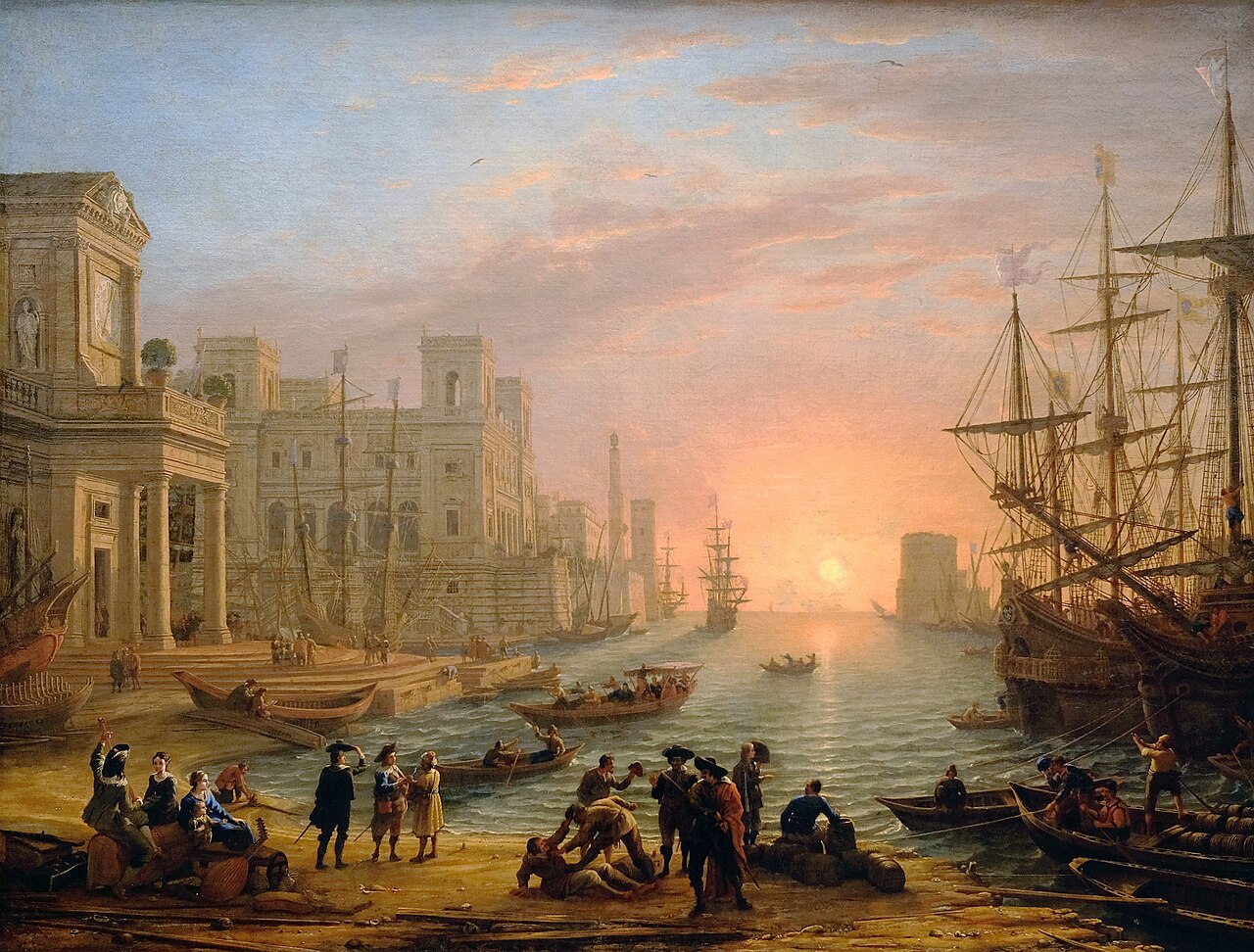
In *The Harbor at Sunset* (1639), Lorrain perfectly captures the twilight light; the reflection of light on the water and the thin mist in the air create a dreamlike atmosphere.
Today, in the Doria Pamphili Gallery in Rome, as the sun sets and real light streams through the windows, merging with the light in Lorrain’s painting, time seems to stand still. Four hundred years have passed, yet the ideal light he created still shines.
Lorrain’s ultimate achievement lies in inventing a way of seeing the world. Before him, landscapes were merely background; after him, landscapes could be protagonists, heroes, and epics. He taught Europeans that an ordinary field, when illuminated by the right light and viewed with the right eyes, could become Arcadia, Eden, and humanity’s eternal nostalgia.
The golden rays in those paintings, the hazy distant mountains, and the tiny figures scattered throughout, together constitute the visual archetype of “ideal nature” in Western culture. In the world Lorrain created, classical and modern, reality and ideal, nature and art achieve a perfect reconciliation. Every time we marvel at a beautiful landscape and say, “This is like a painting,” we are inadvertently paying homage to Claude Lorrain—the poet of light who re-taught us how to see the world.
Related Posts