In recent years, as Chinese antique ceramics have continued to attract attention in the international…
Light of the Great Buddha: Faith and Eternity at Tōdai-ji
Between the mountains of Nara and drifting clouds of cherry blossoms stands a temple whose eaves once echoed with the chants of ten thousand monks, a place where a bronze Buddha has watched over more than a thousand years of history. It is not only a symbol of Japanese Buddhism, but also a mirror reflecting the spiritual heritage of East Asian civilization—Tōdai-ji.
1. Dawn in Nara: The Convergence of Empire and Faith
In the 8th century, Japan was transitioning from the Asuka period to the Nara period. The glowing brilliance of Tenpyō culture had just begun to rise. Buddhism, introduced from China and the Korean Peninsula, had become the spiritual backbone of the ruling class.
When Emperor Shōmu ascended the throne, Japan was plagued by earthquakes, famines, and epidemics. The people were anxious; the government shaken. To pacify the land through Buddhist virtue and restore social harmony, he made a historic decision: to build an unprecedented, magnificent temple—supported by the entire nation—so that “peace may prevail and all beings be at ease.”
Construction of Tōdai-ji began around 728 and lasted more than a decade. It became the head temple overseeing all provincial monasteries under the emperor’s new “kokubunji system.”
Tōdai-ji was thus not merely a temple; it was a fusion of state identity and spiritual ideology.
2. The Birth of the Great Buddha: The Greatest Vow of a Nation
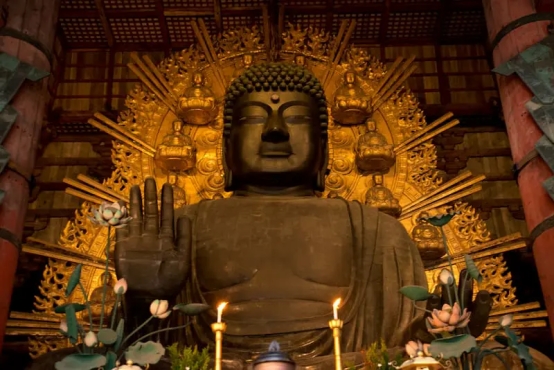
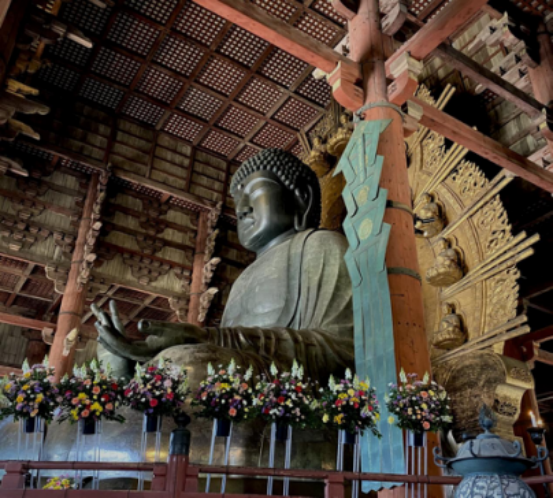
If Tōdai-ji is the heart of Nara, then the Great Buddha seated in the Daibutsuden is the light shining from that heart.
During the hardships of his reign, Emperor Shōmu made a profound vow:
“With the strength of all the people under heaven, let this Buddha be cast, so that suffering may cease and the light of wisdom may illuminate the world.”
The colossal bronze statue—Vairocana Buddha—stands about 15 meters high and was cast from over 500 tons of copper and more than 400 kilograms of gold. It was one of the largest bronze Buddha statues on earth at the time.
The creation of the Buddha was a miracle of collective devotion:
craftsmen, monks, nobles, and commoners all took part
specialists were invited from Tang China and India
the project became a national undertaking of faith
In 752, the Eye-Opening Ceremony was held.
Historical records describe tens of thousands gathered, solemn chants rising to the heavens, the emperor offering incense, and the Tang monk Jianzhen attending the ritual. At that moment, the Buddha opened its golden eyes as if gazing into Japan’s future.
3. A Miracle of Architecture: A Poem of Wood and Empty Space
Tōdai-ji is not only extraordinary for its Buddha; its architecture is itself a marvel.
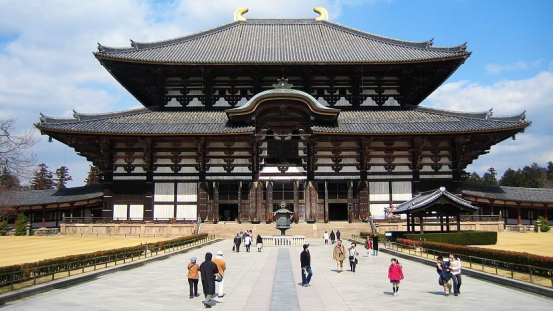
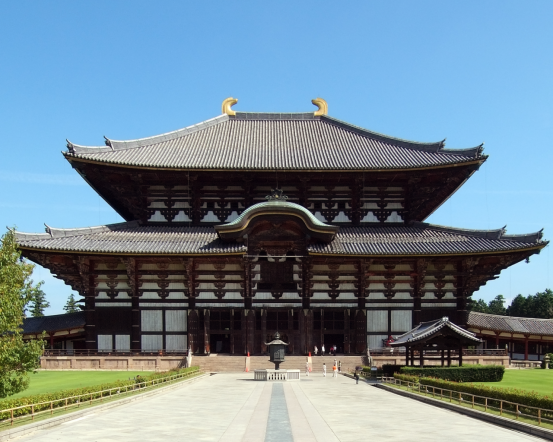
The Daibutsuden, or Great Buddha Hall, is one of the largest wooden structures in the world.
Although the present building is a slightly reduced reconstruction from the Edo period, it remains monumental—57 meters wide and 49 meters tall.
Inside, the warm glow of sunlight touches the bronze surface of the Buddha, creating an atmosphere where time seems to bow its head.
The layout reflects influences from Tang dynasty temples in Chang’an, yet the structure embraces the spirit of Japanese architecture—the warmth of wood, the philosophy of emptiness.
No excessive gold, no overwhelming ornamentation.
The grain of the wood, worn by centuries, becomes the most natural expression of faith.
The stone path leading to the hall, the fearsome Nio guardians of the South Gate, the shadows cast by the corridors, the toll of the giant bell—every part embodies the Japanese aesthetic of silence and harmony.
This architecture does not conquer nature; it converses with it.
4. Fire and Rebirth: A Faith Reconstructed
Yet this symbol of eternity has been consumed by flames more than once.
Wars at the end of the Heian period and again in the Kamakura period burned the Great Buddha Hall to the ground. Even the Buddha itself melted and broke.
But each time, faith resurrected it.
People donated what little they had; craftsmen recast the bronze; monks rebuilt the halls.
Even in times of war and poverty, the Japanese never abandoned the Great Buddha.
This spirit of continual rebuilding lies at the heart of Japanese culture—seeking the eternal within impermanence.
As the writer Jun’ichirō Tanizaki said:
“The beauty of Japan lies in the layers of time and the perseverance of the human heart.”
Every reconstruction of Tōdai-ji is a rekindling of hope.
5. Deer and Sutras: The Resonance of Life and Faith
In the plaza before Tōdai-ji, herds of deer wander freely.
Their presence is not accidental—according to ancient mythology, deer are the messengers of Kasuga Taisha, Tōdai-ji’s Shinto counterpart.
Where Buddhism and Shintoism coexisted, Nara developed a unique aesthetic of harmony and coexistence.
Deer and Buddha, gods and humans, prayers and daily life—everything breathes together.
On misty mornings, deer stroll past the corridors.
Monks chant softly; travelers stand in quiet awe.
At that moment, past and present, the sacred and the ordinary, seem to merge into one.
6. From Ancient Capital to World Heritage: A Legacy Continued
In 1998, Tōdai-ji was designated a UNESCO World Heritage Site as part of the “Historic Monuments of Ancient Nara.”
It remains a spiritual center today.
Each March, the temple holds the Shuni-e (Omizutori) ceremony, symbolizing purification and renewal.
In autumn, monks light lanterns beneath the night sky, the glow of candles mingling with the Buddha’s radiance—dreamlike and timeless.
In an age overwhelmed by noise, Tōdai-ji reminds us:
True strength lies not in volume,
but in inner calm and persistence.
The Great Buddha, seated for twelve centuries, continues to watch silently over the rise and fall of human affairs.
7. Epilogue: The Buddha’s Light, Illuminating the Heart
When sunlight filters through the cherry blossoms of Nara and falls upon the golden face of the Great Buddha, you realize that it is more than a religious symbol.
It is a testament to human faith—
that even through fires, wars, and the erosion of time,
as long as the heart turns toward compassion,
the light of the Buddha never fades.
Tōdai-ji is great not only because of its scale,
but because it teaches us how to face impermanence:
with stillness, with softness, with a faith that reaches toward eternity.
Related Posts