From the lightweight smartwatches on our wrists to the classic analog clocks on our living…

Touching the Threads of Civilization: The Early Printed Books That Changed the World
In an age where screens surround us and information updates by the second, when we walk into a library and see those old books quietly resting in glass cases—their pages yellowed, even bearing traces of wear—do we feel a flicker of curiosity?
These early printed books, hundreds or even thousands of years old, are more than just carriers of text. They represent the first “mass-produced” ideas in human history—a Prometheus who kindled the flame of knowledge.
Today, I invite you to journey back to the dawn of printing, to touch those books that “changed the world.”
From Copying to Printing: A Silent Revolution
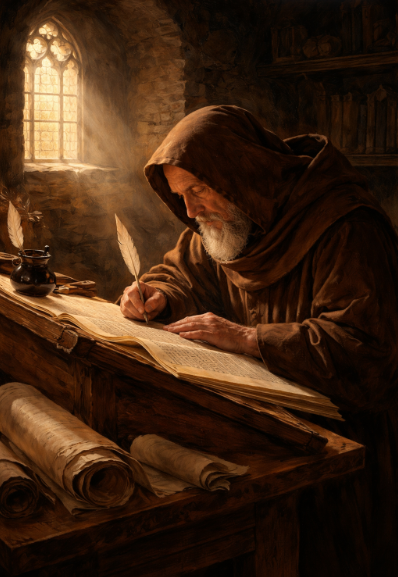
Before the advent of printing, the spread of knowledge was an extravagant luxury. In Europe, monks spent years hunched over desks, using quills to copy parchment letter by letter. A single Bible required at least 300 sheets of parchment—the entire output of a flock of sheep. As a result, a book could cost as much as a farm, and ordinary people could go their whole lives without ever touching a page, let alone reading one.
In China, this bottleneck was broken during the Tang Dynasty. Around the Sui and Tang periods, woodblock printing emerged. Craftsmen carved characters in reverse onto wooden blocks, applied ink, laid down paper, and printed—one page was born. By the Song Dynasty, Bi Sheng invented movable type made of clay, transforming “fixed” wooden blocks into “movable” characters—an invention that predated Gutenberg’s movable-type printing in Germany by about 400 years.
This was a silent revolution: knowledge finally broke free from the monopoly of the aristocracy and clergy and began to flow toward the people.
Sacred Texts of East and West: The Diamond Sūtra and the Gutenberg Bible
If we are to seek the two most representative pioneers among early printed books, they would surely be the Diamond Sūtra in the East and the Gutenberg Bible in the West.
1. The Crown Jewel of the British Library: The Diamond Sūtra
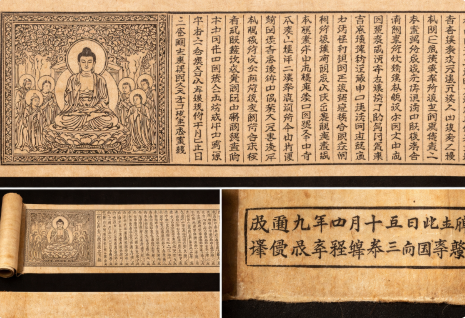
In 1900, the opening of the Library Cave in the Mogao Caves of Dunhuang revealed to the world a copy of the Diamond Sūtra from the ninth year of Xiantong in the Tang Dynasty (868 CE). This is not only the earliest surviving dated woodblock-printed book but also a flawless work of art.
Stretching over five meters in scroll form, its carving is masterful, its ink evenly applied. Particularly striking is the frontispiece illustration—”Vulture Peak”—with its precise composition and delicate lines. It is astonishing to think that by the 9th century, Chinese artisans had already mastered the craft of printing to such a refined degree. The colophon clearly states: “Printed on the 15th of the fourth moon in the ninth year of Xiantong, by Wang Jie, made for the benefit of his parents.” This tells us that printing was no longer an official secret but had entered the realms of folk belief and daily life.
2. The “Technological Singularity” of the West: The Gutenberg Bible
Fast forward to 15th-century Germany. Around 1455, a metalworker named Johannes Gutenberg completed a groundbreaking invention.
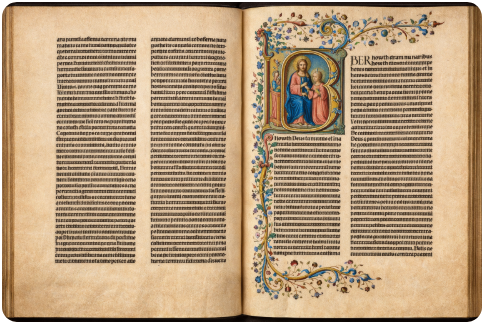
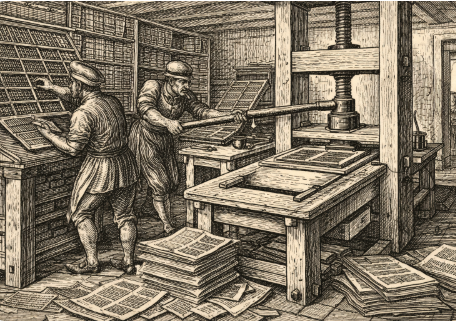
He not only created metal movable type suitable for the European alphabet but also developed an oil-based printing ink and adapted a wooden press (similar to a wine press). The combination of these three innovations led to a quantum leap in printing efficiency. The Forty-Two-Line Bible (so named because each page has 42 lines) is widely recognized as the first major book printed using movable type in the West.
Although Gutenberg came later than Bi Sheng, his printing system—with its comprehensive integration of casting, typesetting, and mechanical printing—sparked a transformation in the Western world. The appearance of this book directly fueled the Protestant Reformation, because ordinary people could now read the Bible for themselves, rather than relying solely on the oral interpretations of the clergy.
The Book as a Commodity
Early printed books were, in fact, much like today’s bestsellers: they were the “high-tech products” of their time.
In less than 50 years after Gutenberg’s invention, the number of printing shops in Europe grew from zero to hundreds, producing over ten million volumes. Booksellers began setting up stalls at markets. Many of these books did not have the ornate, finely bound covers we associate with them today. Buyers often purchased loose or unbound sheets and then, depending on their budget and taste, would have a binder craft a custom cover, sometimes adding metal clasps (to prevent the parchment from curling).
In other words, owning a book in that era meant possessing not only knowledge but also a personalized “affordable luxury.”
Why Do These Old Books Still Matter?
Some might ask, in this digital age, why should we still care about these ancient printed artifacts?
First, they record the formatting of civilization. As Marshall McLuhan famously said, the medium is the message. The advent of printing cultivated linear thinking, logical reasoning, and the standardization of national languages. Without printing, there would have been no scientific revolution and no industrial revolution—at least not in the form they took.
Second, they carry a human warmth. When you see on a Gutenberg Bible the heavy smudges of ink left behind by a printer who applied too much, or when you notice on a Dunhuang scroll the corrections made by an ancient scribe after an occasional error—you realize that books were never just cold text; behind them were living, breathing people.
Third, they remind us of the value of “slowness.” In today’s information-saturated world, we are accustomed to scrolling and fragmented reading. These early books—from carving to typesetting to binding—each step demanded immense time and care. Their existence invites us to reconsider: are we merely consuming information, or are we truly absorbing knowledge?
Conclusion
Every early printed book that survives to this day is a survivor of time. They have escaped wars, floods, and insects, weathered the censorship of banned book lists, and reached us bearing the marginalia and warmth of those who came before.
The next time you encounter them in a museum or a rare book exhibition, I hope you don’t see them merely as “antiques.” Imagine instead the awe that must have gripped people when they first laid eyes on a printed book—an awe perhaps not unlike the astonishment of putting on a VR headset for the first time today, or watching ChatGPT produce fluent prose in an instant.
It was the first moment humanity realized: ideas can be immortal.
Related Posts