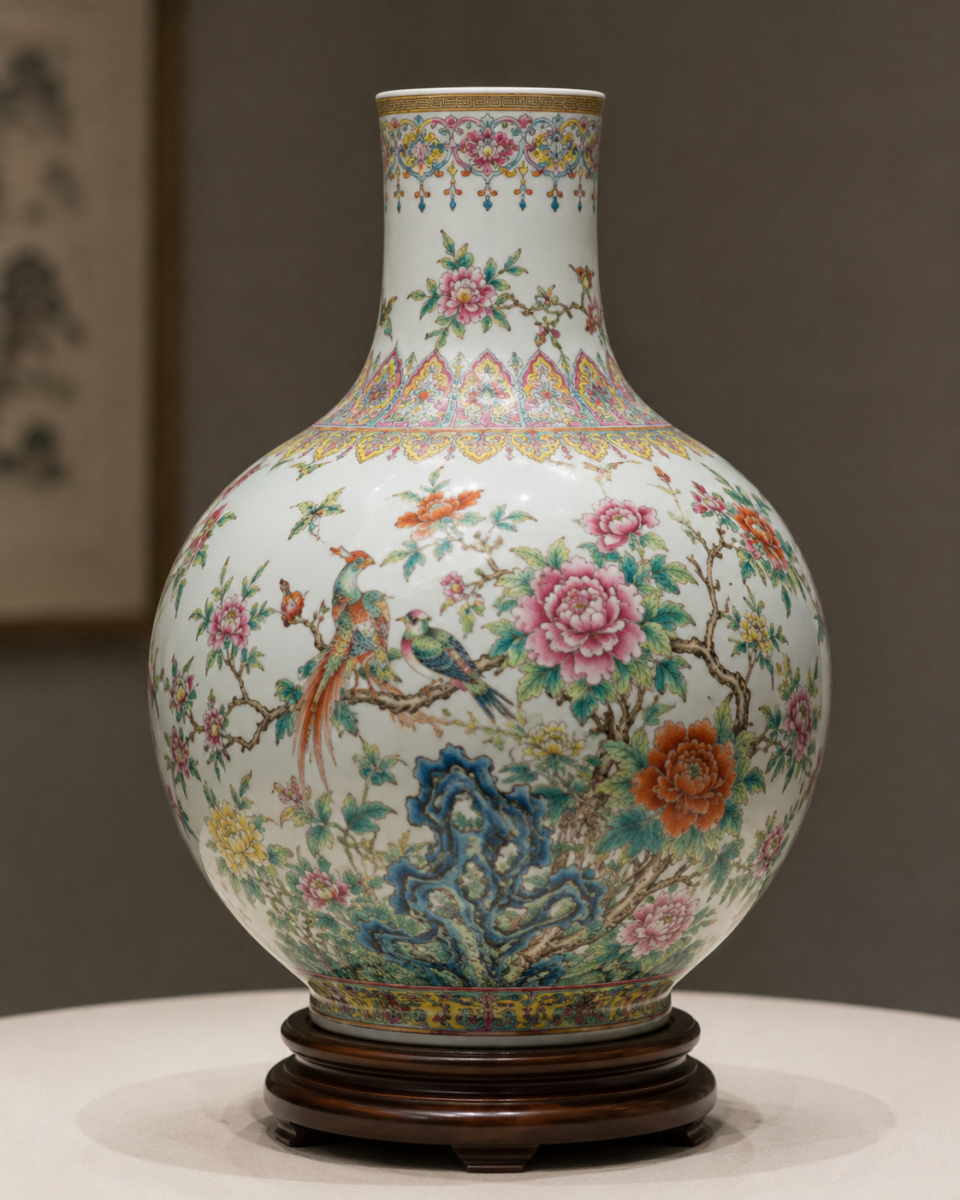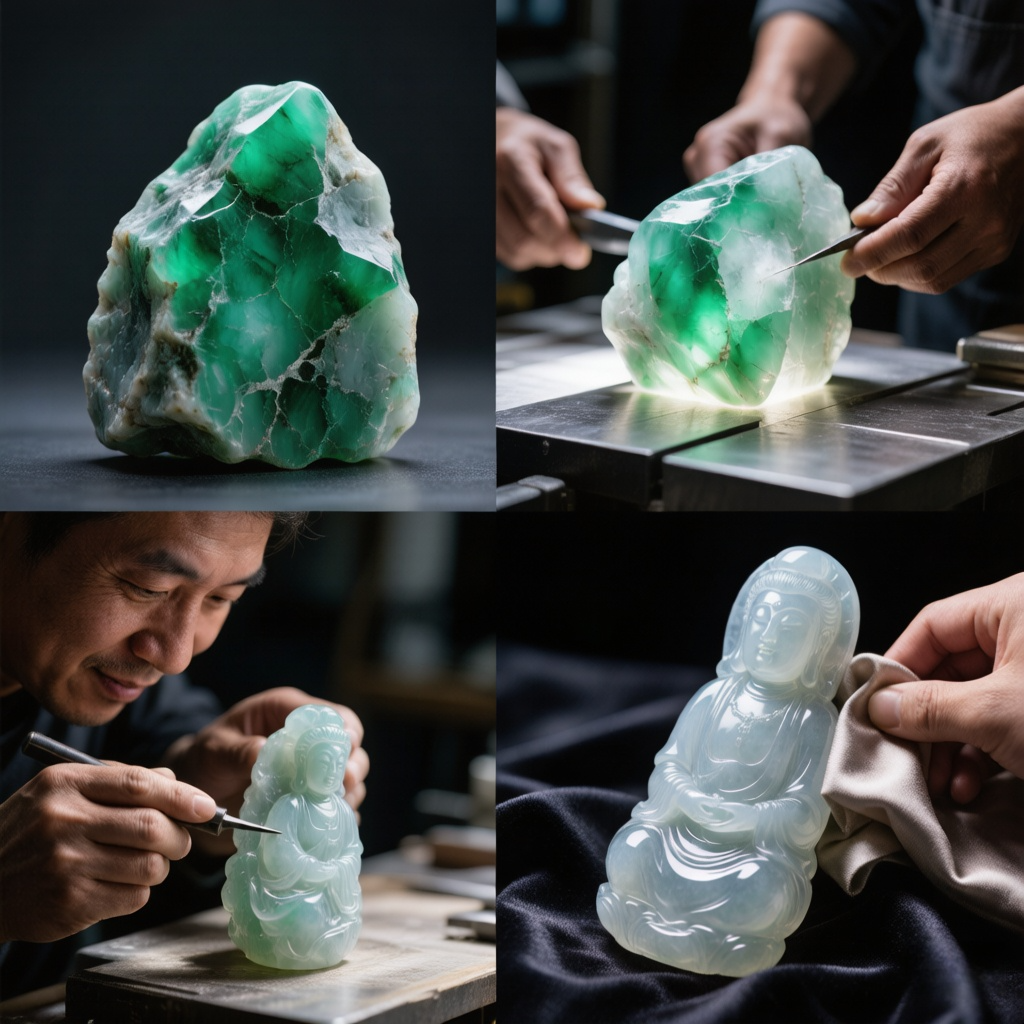
In recent years, as Chinese antique ceramics have continued to attract attention in the international…
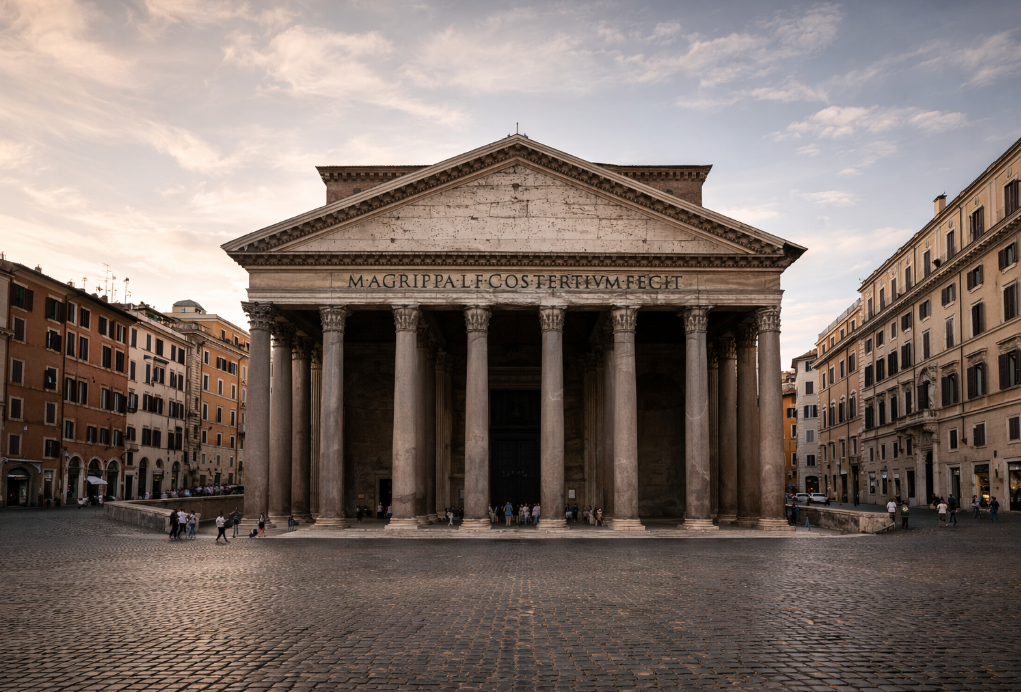
The Pantheon: When Engineering Becomes a Path to the Divine
Among the many ancient monuments of Rome, the Pantheon feels unusually quiet. It does not speak of history through ruin, nor does it overwhelm the eye with sheer monumentality. Instead, it stands at the center of time with an almost rational restraint. Two thousand years on, the building remains intact, as if it had been conceived from the very beginning as a form of eternity.
The Pantheon was first built in antiquity, with the structure we see today completed during the reign of Emperor Hadrian. It was not dedicated to a single deity, but to all gods. This inclusive vision of faith shaped the architectural language itself—one that does not rely on specific divine images, but seeks a universal order instead.
I. The Dome: A Geometric Model of the Cosmos
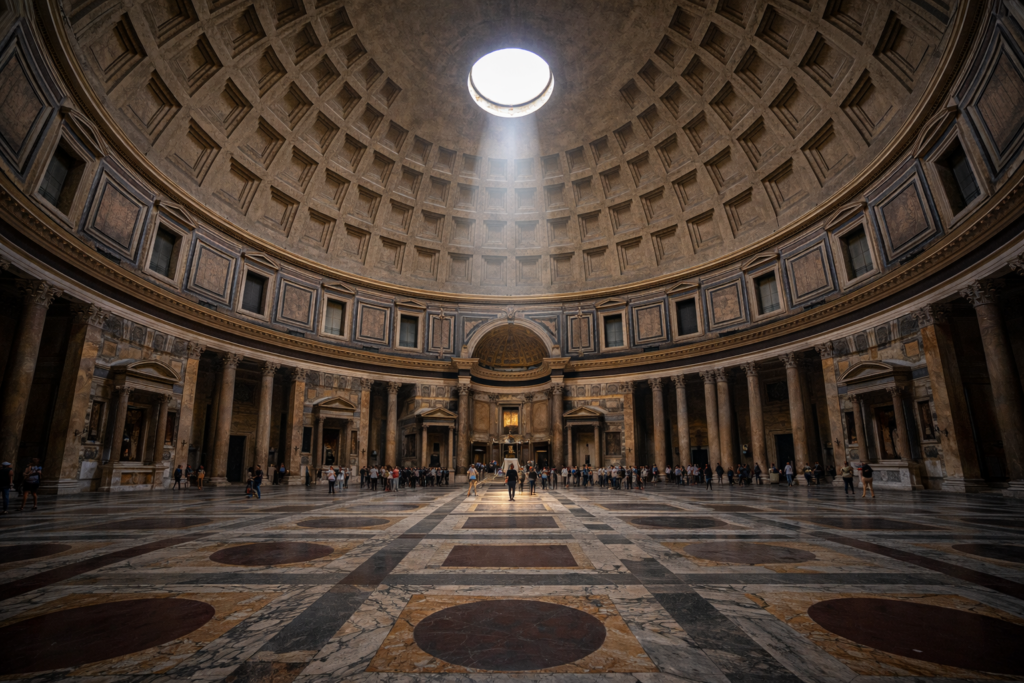
Upon entering the Pantheon, what one feels first is not decoration, but space itself. The dome—whose diameter and height are nearly equal—forms a proportion close to that of a perfect sphere. In the Roman conception of the universe, the sphere symbolized wholeness, harmony, and eternity. Here, architecture ceases to be merely a setting for ritual and becomes a microcosm of the cosmos.
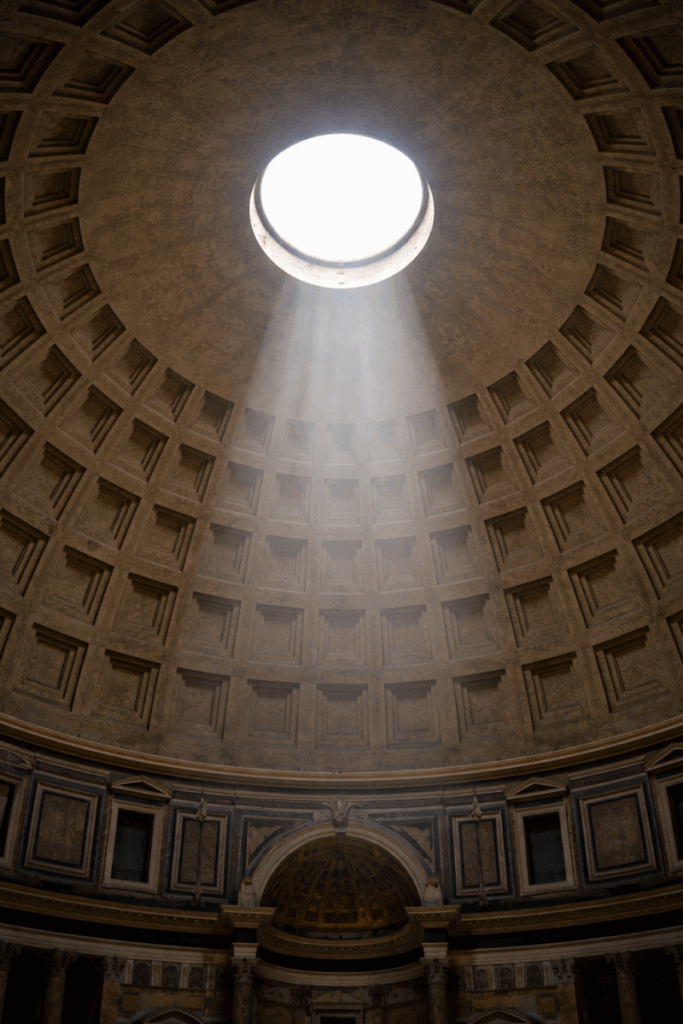
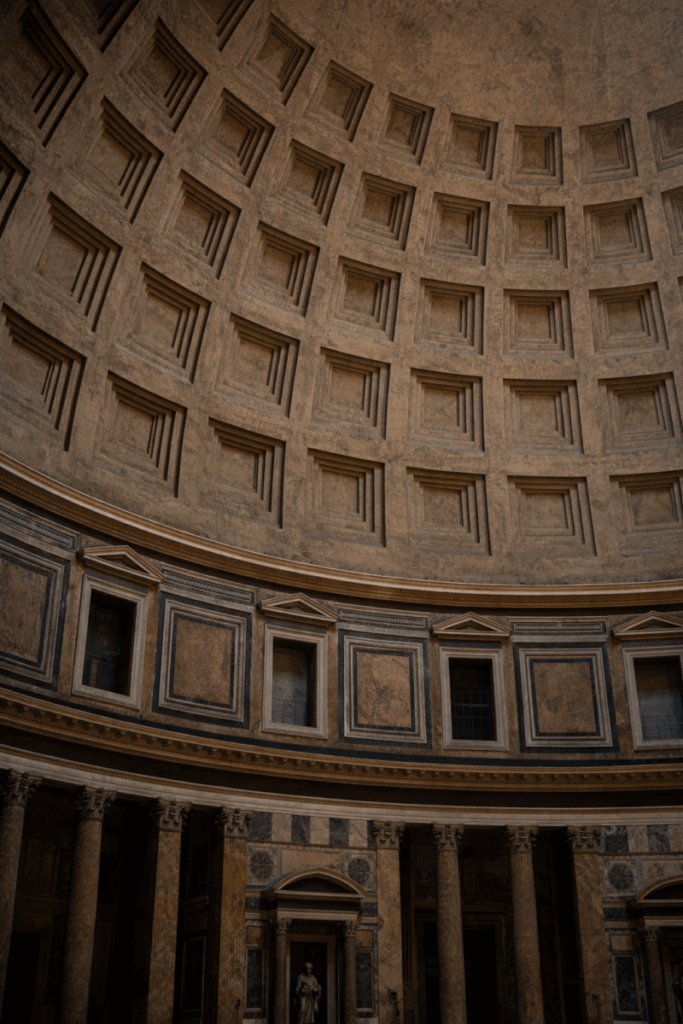
The coffers on the inner surface of the dome are not mere ornament. They are precise engineering decisions: visually, they reinforce rhythm and depth; structurally, they reduce weight, allowing such a vast space to exist. Reason and beauty are not in opposition here, but different expressions of the same underlying logic.
II. The Oculus: Introducing Light and Time
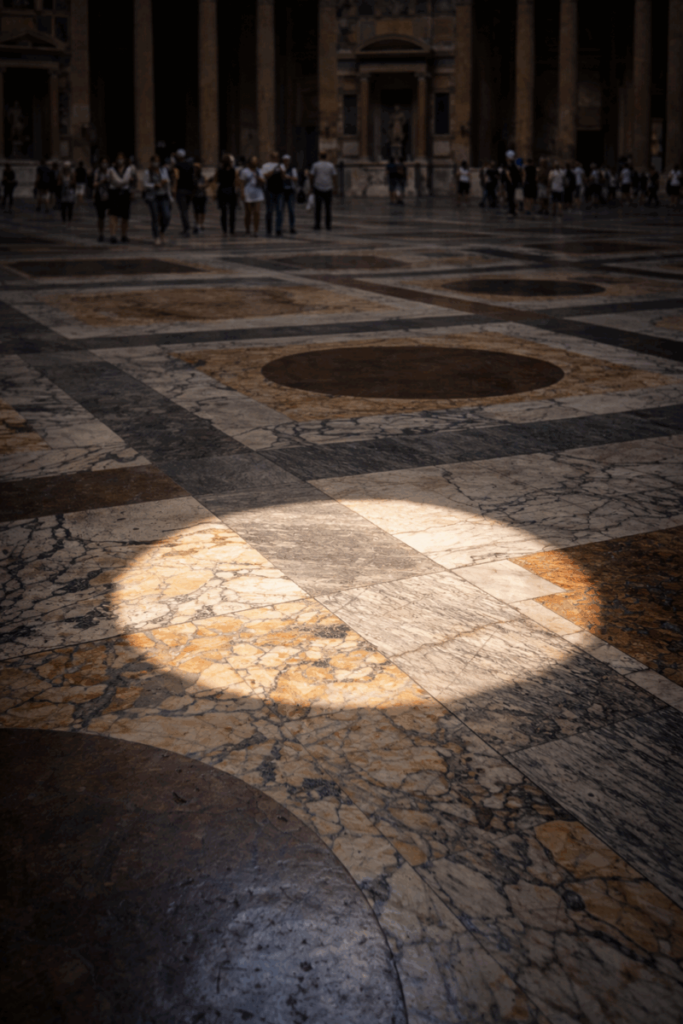
At the center of the dome is a circular opening known as the oculus. It is the building’s only source of natural light. From above, light falls vertically into the interior, slowly moving across the floor and walls as time passes, creating a visible flow of time within the space.
In an age without clocks, this beam of light functioned as a ritual of time itself. It draws the sky directly into the interior, allowing nature to become part of the architecture. Divinity is no longer carved or depicted—it exists here in the form of light.
III. Engineering with Confidence: Concrete and Order
To this day, the Pantheon remains the largest unreinforced concrete dome in the world. This fact alone speaks to the extraordinary sophistication of Roman engineering. Concrete of varying densities was used at different levels—from heavy stone aggregates at the base to lightweight volcanic materials near the crown—embedding structural logic beneath a surface of visual calm.
This is not architecture that seeks to show off its technique, but one that expresses profound confidence. Technology here does not demand attention; it has been fully absorbed into an overarching sense of order.
IV. Space as Belief
Unlike later churches, the Pantheon does not attempt to guide belief through narrative. There are no murals recounting myths, no sculptures establishing a focal point of worship. Instead, the individual stands face to face with space itself.
This experience of belief is inward and abstract. Enveloped by proportion, light, and silence, one arrives naturally at a sense of reverence. It is a form of spirituality that does not rely on language.
V. Legacy: From Antiquity to the Modern World
The Pantheon’s influence on later architecture has been profound and enduring. From St. Peter’s Basilica in the Renaissance, to Neoclassical government buildings, and onward to modern museums and civic spaces, the ideas of the dome and the centralized plan have been continually inherited and reinterpreted.
What the Pantheon established was not merely a form, but a way of thinking:
that architecture can reach the sacred through reason, and create spiritual experience through order.
Conclusion: The Divinity of Reason Itself
The greatness of the Pantheon does not lie in its association with any single religion or empire, but in the timeless possibility it proposes—when engineering, mathematics, and aesthetics achieve true unity, human reason itself acquires a divine dimension.
Standing at the center of the Pantheon, gazing up at the circle of sky above, one realizes this:
the deepest power of civilization is often not loud or dramatic, but exists quietly—through structure, light, and time.
Related Posts