In the 17th century, as Baroque art swept across Europe, one French painter chose a…
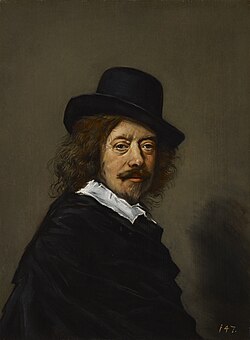
Frans Hals: The Eternity of the Moment, the Portrait Magician of the Dutch Golden Age
On the banks of the canals in Haarlem, Netherlands, a painter was creating an art historical miracle—he wasn’t painting static portraits, but capturing life itself. Frans Hals (c. 1582/83–1666), a painter a generation older than Rembrandt, revolutionized portraiture with his unique “sketching” brushstrokes. On his canvases, smiles were, for the first time, so real and natural, the figures seeming ready to step out of the frame and converse with their subjects.
Haarlem Flemish Immigrants: Early Years (c. 1582–1610)
Frans Hals was born in Antwerp during the Eighty Years’ War, the Dutch resistance against Spanish rule. Around 1585, after the fall of Antwerp to the Spanish, his family—like many other Protestants—migrated north, eventually settling in Haarlem. This city later became the center of his life’s artistic activity.
The Mystery of His Mentorship: Little is recorded about Hals’s early training. Traditionally, he is believed to have been a student of the Haarlem painter Karel van Mande, but it is more likely that he studied in the workshops of several local painters. In 1610, he joined the Haarlem Guild of St. Luke, marking the beginning of his career as an independent painter. That same year, he married Annette Hammansdot, but she died in 1615 after giving birth to two children.
Breakthrough Work: *The Feast of the St. George Militia* (1616)
In 1616, Hals, only in his early thirties, received the first major commission of his career: to paint a group portrait of the Haarlem St. George Militia. This was a popular form of portraiture in Holland at the time, with militiamen pooling their money to have a painter capture their collective image.
Revolutionary Group Portrait: Traditional Dutch group portraits were usually stiff arrangements, with each figure staring directly at the viewer with a serious expression. Hals’ *The Feast of the St. George Militia* completely broke this mold. He placed the officers in a seemingly natural banquet scene: some raised their glasses in toasts, some turned to the side to converse, some looked directly at the audience, and some gazed elsewhere. The scene was dynamic and lively, as if capturing a moment from the banquet.
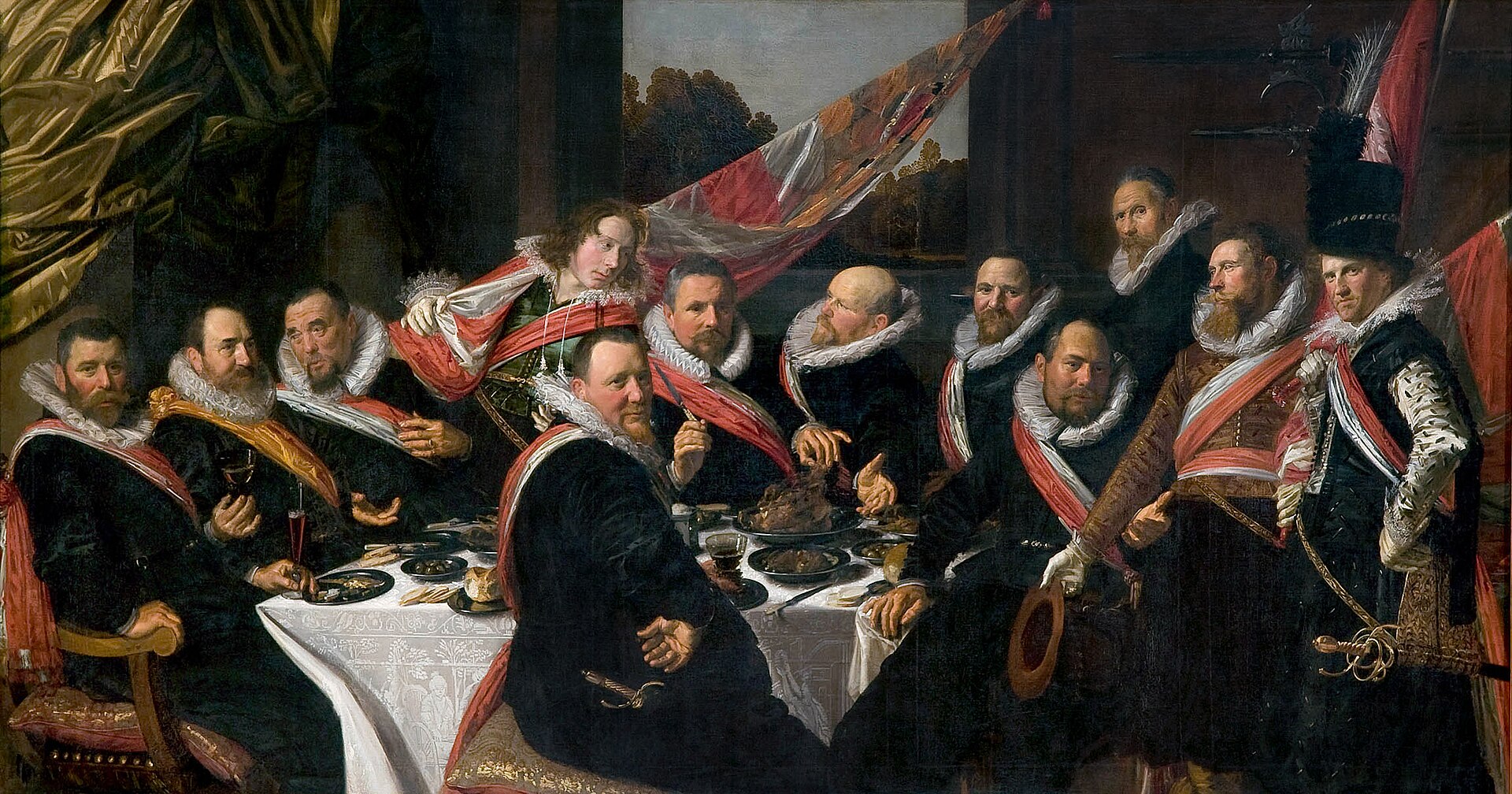
*The Feast of the Militia of St. George* (1616), Hals’s breakthrough work, revolutionized the face of Dutch group portraiture.
This painting immediately caused a sensation. Hals demonstrated an unprecedented ability: he captured not only the physical features of his subjects but also their character, emotions, and fleeting interactions. This “instantaneity” became the hallmark of his art.
The Golden Age of Portrait Painting (1620-1640)
The next two decades were Hals’s golden age. He became the most popular portrait painter in Haarlem, with clients including wealthy merchants, city councilors, scholars, and clergy. But his most famous works are his informal “character studies.”
The Revolution of Laughter: Hals was the first painter in Western art history to systematically depict smiles. Before him, portrait subjects typically wore serious expressions because maintaining a smile for an extended period was nearly impossible for the model. But Hals developed a rapid, direct painting technique capable of capturing fleeting expressions.
Works such as *The Smiling Officer*, *The Lute-Playing Clown*, and *The Happy Drunkard* showcase a wide variety of smiles: from elegant smiles to hearty laughter, from sly grins to drunken smirks. These smiles are so real that the viewer can almost hear the laughter.
A Revolution in Brushstrokes: Hals’s technique was equally revolutionary. He employed loose, free brushstrokes that appear lifelike from a distance, but up close reveal seemingly random blocks of color and lines. This technique foreshadowed Impressionism two centuries later. He often did not create detailed sketches beforehand, but rather painted directly on the canvas, preserving the freshness of the first impression.
In the 1620s and 1630s, Hals created a series of outstanding portraits, including the famous *Malle Barbey* (also known as *The Witch of Haarlem*), depicting a well-known, distinctive old woman whose vivid expression and rough brushstrokes reveal Hals’s profound insight into human nature.
The Pinnacle of Citizen Portraits and Group Portraits
Hals was not only a master of individual portraiture but also revolutionized group portraiture. Following his success in 1616, he painted group portraits of several militia companies and administrators of charitable institutions in Haarlem.
A Mirror of Civil Society: These works reflect the social structure of the Dutch Republic. The militia companies represented civic self-defense organizations and social clubs; the administrators of charitable institutions (regency) represented the city’s welfare system. Hals transformed these group portraits into vivid social scenes, where each individual was both unique and part of the collective.
The most famous group portraits include *Officers of the Militia Company of St. Adrian* (c. 1627) and *The Regent of St. Elizabeth’s Hospital* (1641). The latter is particularly striking: Hals did not glorify these elderly female administrators but realistically depicted their serious, even somewhat stern, faces, showcasing the values of Dutch Calvinist society.
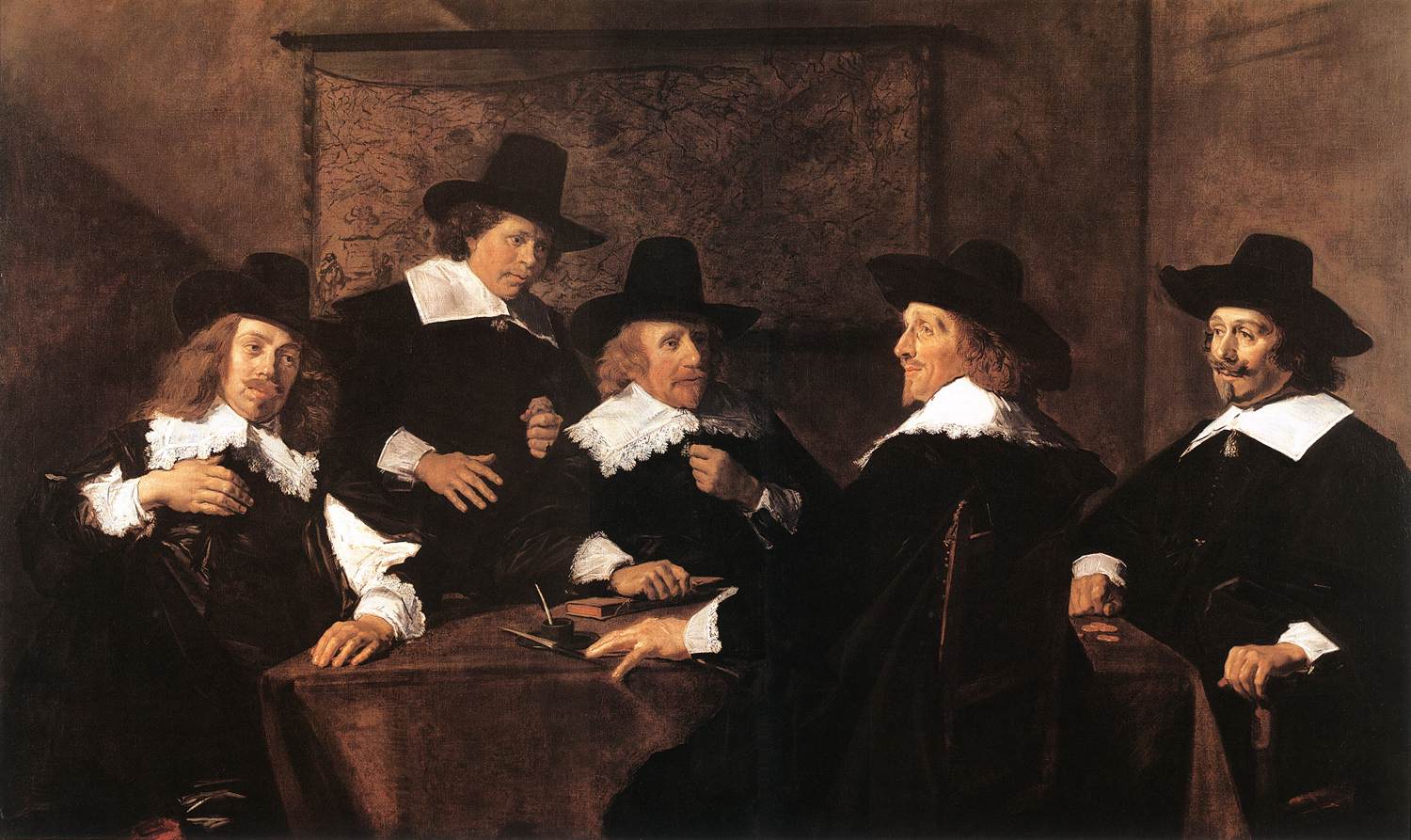
*The Regent at St. Elizabeth’s Hospital* (1641), a masterpiece of group portraits from Hals’ late period, depicts the administrators of a charitable institution with profound psychological insight.
Later Adversity and Stylistic Evolution (1640-1666)
After the 1640s, Hals’ popularity began to decline. New artistic tastes shifted towards a more refined and polished style, and Hals’s rough brushstrokes were no longer fashionable. He fell into financial difficulties, even having to sell his possessions to pay off debts in 1654. In 1662, the Haarlem city government began providing him with an annual stipend and fuel allowance to help the aging painter make a living.
From Color to Chiaroscuro: Interestingly, it was precisely during this period of economic hardship that Hals’s art reached new depths. His later works became more restrained in color, dominated by black, white, and gray tones, but his brushstrokes became freer and more confident. The psychological depictions of the figures also became more profound and introspective.
His most famous late works are *The Regent in the Nursing Home* and *The Regent in the Nursing Home* (c. 1664). In these paintings, the figures are almost entirely immersed in their inner world, their expressions serious and their postures restrained. The brushstrokes become extremely economical, sometimes capturing facial features and the texture of clothing with just a few strokes. This “less is more” minimalism foreshadows certain aspects of modern painting.
Forgotten and Rediscovered
Hals died in Haarlem on August 26, 1666, and was buried in St. Basil’s Cathedral. After his death, he was quickly forgotten, only occasionally mentioned in art history books. This situation did not change until the mid-19th century.
A Pioneer of Impressionism: In the 1860s and 70s, French artists and critics “rediscovered” Hals. Édouard Manet was deeply moved after seeing Hals’s work during a visit to Haarlem. Hals’s rapid, direct brushstrokes, his ability to capture fleeting light and expression, and his bold breakthroughs in traditional composition profoundly influenced Manet and later Impressionist painters.
In a letter to his brother Theo, Vincent van Gogh wrote, “François Hals has as many as twenty-seven shades of black!” Van Gogh admired Hals’ ability to create rich effects with a limited palette.
A Prophecy of Modernity: In the 20th century, Hals was hailed as a “pioneer of modern painting.” His unfinished surfaces, visible brushstrokes, and pursuit of the fleeting moment broke with the Renaissance tradition of striving for perfection and smooth surfaces. He proved that a painting could be both a completed work of art and a record of the creative process.
A Serious Artist Behind the Smile
Hals is often misunderstood as a painter who only depicted joyful scenes, but a closer look at his work reveals a deeper complexity. Behind his smiles often lies melancholy, irony, or social commentary. His depictions of “ordinary people”—drunkards, musicians, children, the elderly—reveal the lives of various social classes during the Dutch Golden Age.
A Democratic Perspective: Hals’ greatness lies in his egalitarian perspective. He painted militia officers and mayors, as well as drunkards and clowns, all with the same respect and profound humanity. In his paintings, each figure has a unique personality and is an individual worthy of attention and depiction.
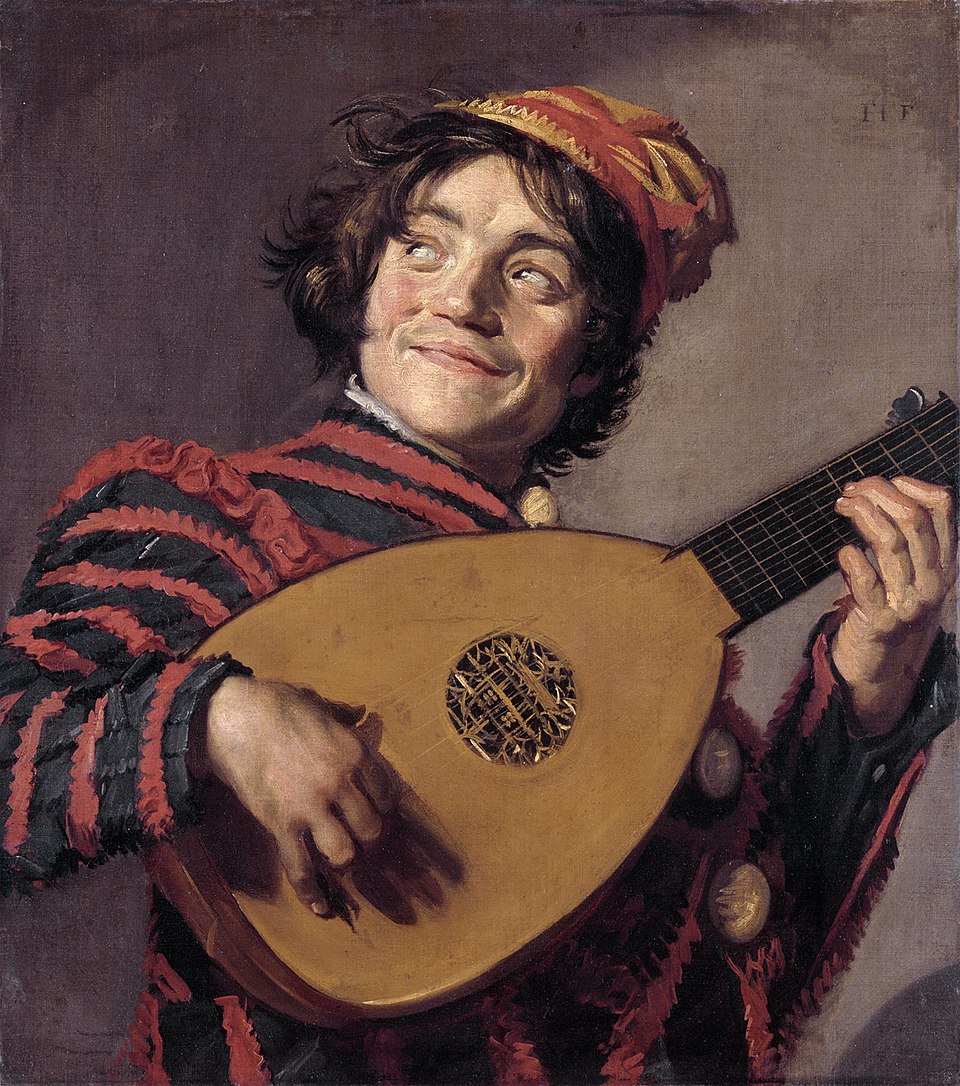
*The Lute Player* (c. 1623-24), a typical figure study by Frans Hals, showcases his extraordinary talent in capturing fleeting expressions and vivid gestures.
Today, when we gaze upon his works at the Frans Hals Museum in Haarlem or the Rijksmuseum in Amsterdam, the four-hundred-year gap seems to disappear. The figures in the paintings remain vibrant, still smiling, still conversing, still living. This is Hals’s magic: he captured the passage of time with paint, yet made the moment eternal.
Frans Hals was not a painter depicting perfection or ideals; he was a painter depicting life—imperfect, fleeting, and tangibly real. Among the masters of the Dutch Golden Age, Rembrandt explored the depths of the soul, Vermeer pursued the perfection of light, while Hals captured the pulse of life. His brushstrokes are as powerful as a heartbeat, his colors as vibrant as breath, reminding us that art need not strive for eternal beauty, but simply to honestly confront life itself—including its joy, its fragility, its transience. And this, perhaps, is the most profound eternity.
Related Posts