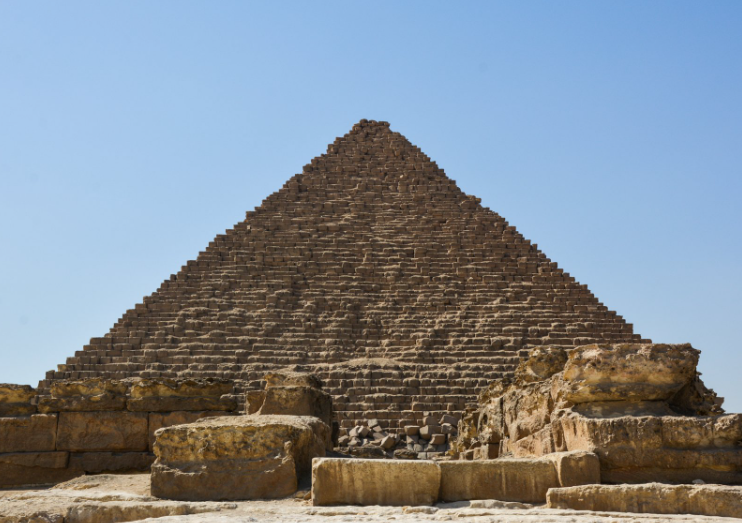
The pyramids: More than just tombs, they are the ladder to heaven for ancient Egyptian civilization.
Before going to Egypt, my understanding of the pyramids was the same as most people’s:…

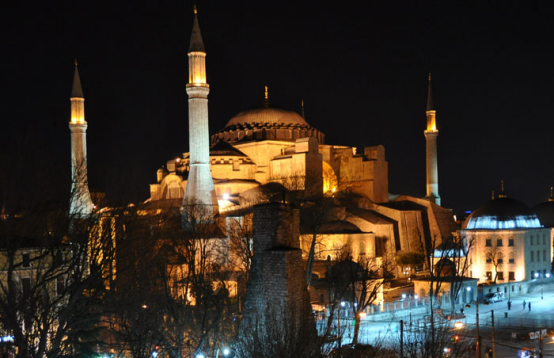
On the skyline of Istanbul stands a building that belongs to no single era, no single faith. It has witnessed the rise and fall of empires, heard both church bells and the call to prayer, and seen war and peace unfold before its walls. It is where world civilizations meet, a witness to the passage of time—the Hagia Sophia.
I. From the “Holy Wisdom”: The Glory of an Empire
In 537 AD, in the Byzantine capital of Constantinople, Emperor Justinian I stood at the center of his newly completed basilica. Gazing up at the enormous golden dome, he uttered the words that echoed through history:
“Solomon, I have surpassed you!”
In that moment, Hagia Sophia was not merely a church; it was a symbol of imperial power and divine faith.
“Hagia Sophia,” in Greek, means “Holy Wisdom”—not referring to a saint, but to the divine wisdom of God. Its creation was Justinian’s attempt to restore the splendor of his empire through a masterpiece worthy of heaven itself. Two earlier churches bearing the same name had fallen to rebellion and fire, and this time the emperor vowed to build “a house of God that would shake the earth.”
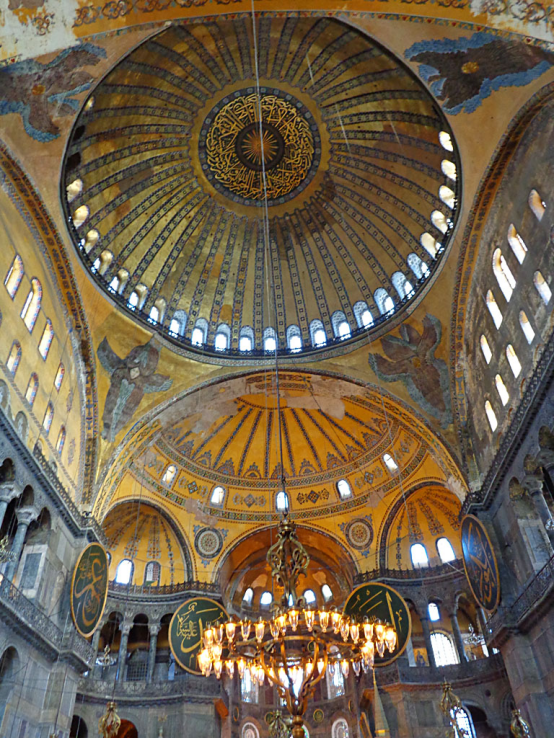
Architects Anthemius and Isidore combined the dome-building genius of Rome with the spatial aesthetics of the East. The central dome, soaring 55 meters high, rested on four massive arches, appearing almost to float upon a sea of light. Dozens of windows encircling its base allowed sunlight to pour in, creating the illusion of a radiant, suspended halo.
To people of the time, this was not simply architecture—it was a miracle made visible.
II. A Sanctuary of Light and Gold: The Heart of Byzantium
Stepping into Hagia Sophia, one is first struck by light.
Golden beams cascade from more than seventy windows, glimmering across mosaics, columns, and polished marble floors, transforming the entire space into a shimmering holy realm.
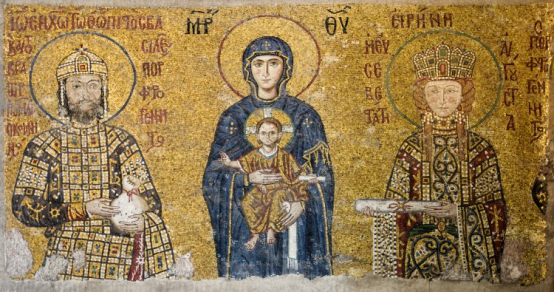
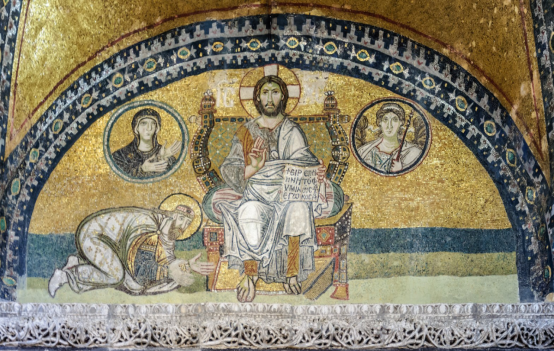
The golden mosaics depict Christ, the Virgin Mary, and angels, each tiny tessera capturing the exquisite, mysterious beauty of Byzantine art. In the center of the dome, the Pantokrator, the “Christ Almighty,” gazes down at the faithful with a solemn yet gentle expression that has endured for centuries.
Hagia Sophia was more than a church—it was the spiritual heart of Byzantium.
Here, emperors were crowned, patriarchs preached, and the destiny of the empire intertwined with divine will. It symbolized sacred order, bridging the earthly empire and the heavens above.
Yet beneath this brilliance lay fragility. As centuries passed and the empire faltered under the weight of wars and internal strife, the golden glow of Hagia Sophia dimmed beneath the shadows of uncertainty.
III. Prayer Beneath the Crescent: A New Empire Rises
In 1453, Constantinople fell to Sultan Mehmed II of the Ottoman Empire. That day, the doors of Hagia Sophia reopened—but the language of prayer had changed.
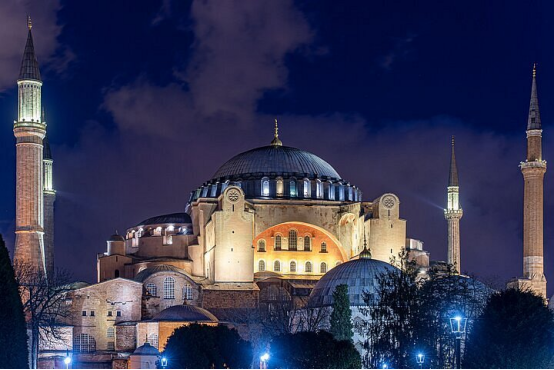
Hagia Sophia became a mosque, the Ayasofya Camii.
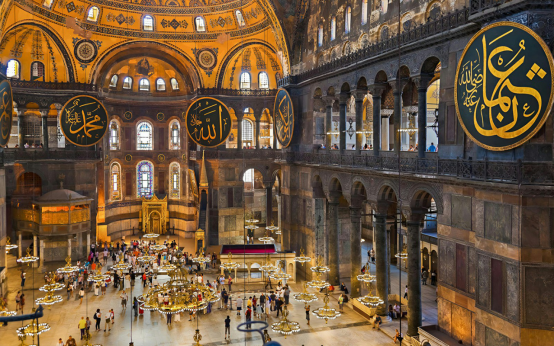
The Christ of the dome was veiled, replaced by elegant Arabic calligraphy proclaiming the name of God. Four slender minarets rose around the ancient dome, binding the sky of Byzantium with the spirit of Islam.
Yet the Ottomans did not destroy its soul.
The sultan ordered the preservation of its structure and decorations, treating it as a treasure of faith. The great architect Mimar Sinan reinforced the building, ensuring its survival through earthquakes and the passage of centuries. Thus, Hagia Sophia became something unique—a structure no longer confined to a single faith, but a symbol of civilizational fusion.
Within its walls, prayers had once been chanted in Greek; later, they resonated in Arabic. Its stone walls hold the words of two religions; its dome has reflected both the cross and the crescent. It is a witness to conflict—and a miracle of coexistence.
IV. Dust and Revival: A Modern Reflection
In 1935, Mustafa Kemal Atatürk, founder of the Republic of Turkey, declared Hagia Sophia a museum—an act rich in symbolism. This transformed a building long marked by religious contention into a cultural heritage shared by all humankind.
Hidden mosaics were unveiled, and golden light once again flooded the dome. Visitors from every nation, regardless of religion or race, found within it a profound and universal peace.
But Hagia Sophia’s destiny continues to shift.
In 2020, the government of Turkey announced its reconversion into a mosque, drawing worldwide attention.
Some called it a return to faith; others, a step backward.
Yet whatever the interpretation, Hagia Sophia still stands—
having endured the rise and fall of empires, changes of faith, and the cycles of war and peace.
Its essence now transcends politics and religion. It has become a metaphor for civilization itself.
V. The Dome of Light: An Eternal Symbol
When sunlight streams through the dome’s windows, spilling across ancient marble, time seems to pause.
Hagia Sophia stands as an eternal miracle of world architecture:
a triumph of engineering—suspending an impossible dome in the air;
a sanctuary of art—where Byzantine brilliance meets Islamic calligraphy;
a symbol of faith—where devotion endures even as forms change.
Its meaning lies not only in stone and gold, but in the lessons it offers about continuity and coexistence.
On this land bridging Europe and Asia, Hagia Sophia reminds the world that civilizations are not isolated—they illuminate one another.
Its dome is a mirror, reflecting humanity’s deepest question:
Why do we build monuments so grand?
Perhaps the answer is simple:
Because humanity has always been reaching for light.
Epilogue: Echoes of Time
Hagia Sophia is not a silent monument; it is a living epic.
Every stone, every crack records the breath of a thousand years.
It has witnessed the glory and fall of empires, yet has never truly fallen silent.
Today, if you stand beneath that golden dome and look up into the light that seems to float above, you will realize—
It is not only the light of a building,
but the enduring hope of human civilization, glowing in the depths of time.