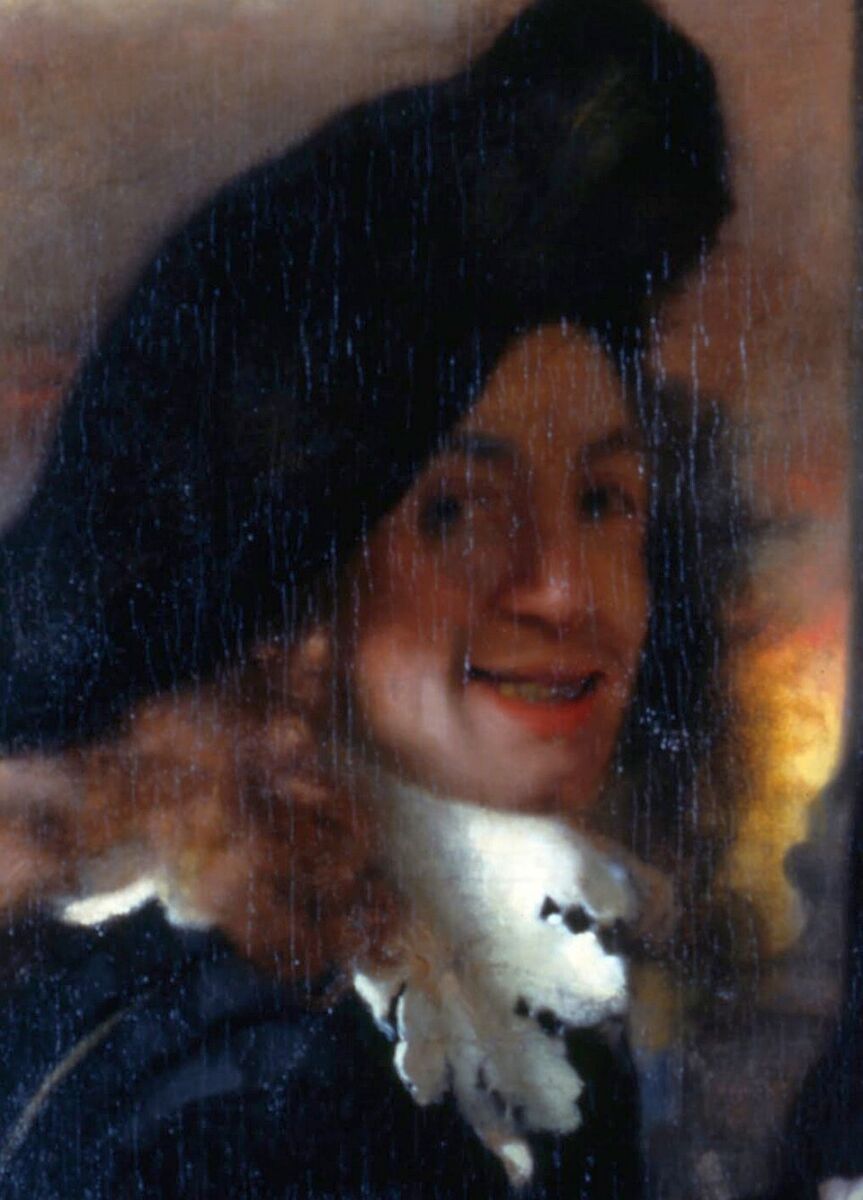
The Milkmaid (c. 1657-1658), a prime example of Vermeer's use of light and everyday poetry.…
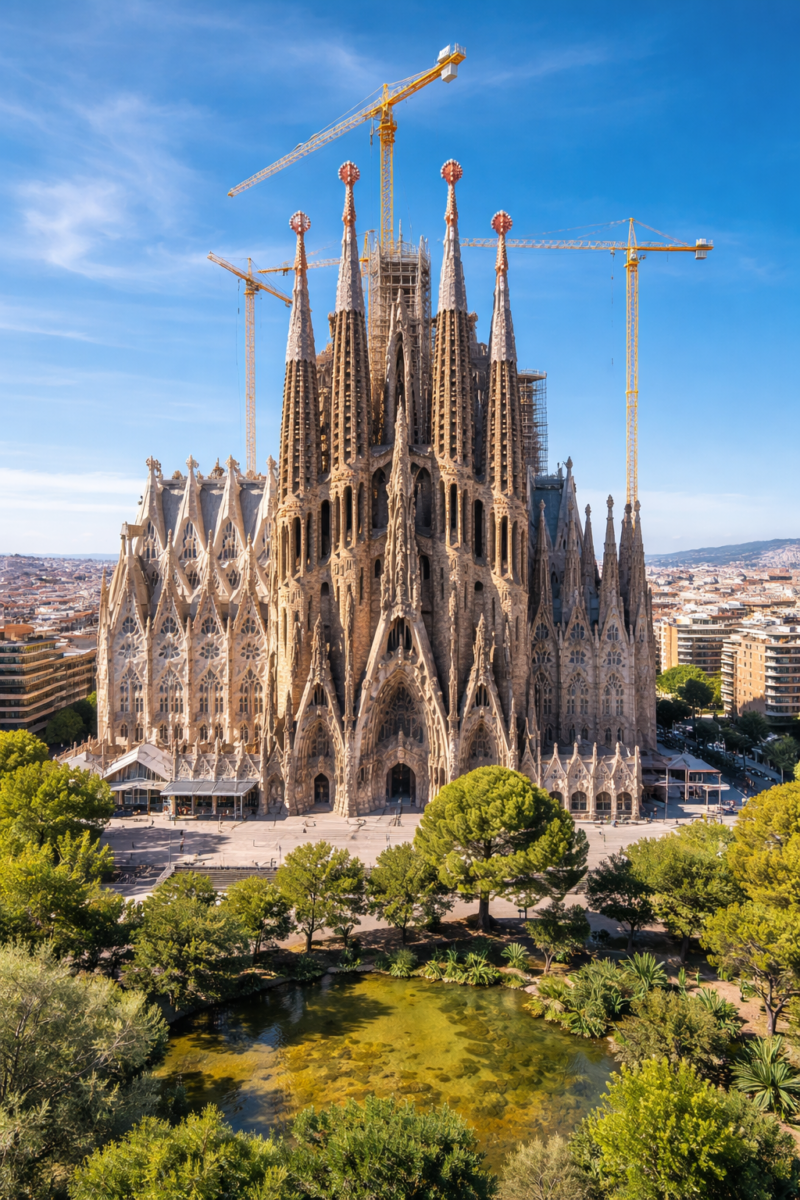
A Symphony of Light and Time: The Centennial Epic of the Sagrada Familia
In the heart of Barcelona, Spain’s Catalonia region, stands a church that belongs neither entirely to the past nor fully to the future. It is the world-renowned Sagrada Familia. More than an architectural masterpiece, it is a century-spanning experiment in time—a magnificent narrative of faith, nature, and human creativity.
I. The Unfinished Miracle: Architecture Sculpted by Time
Construction of the Sagrada Familia began in 1882 under architect Francisco de Paula del Villar. Soon after, the project found its true visionary in Antoni Gaudí, who took over in 1883.
Gaudí transformed the original Neo-Gothic plan into something entirely unprecedented, introducing an “organic architecture” inspired by nature itself. The structure seems to grow like a living organism, rising upward like a forest of stone.
Yet the project was destined to be long and complex. When Gaudí died in 1926, only the crypt, apse, and part of the Nativity Façade were complete. Tragically, during the Spanish Civil War, many of his original models and plans were destroyed, bringing construction nearly to a halt.
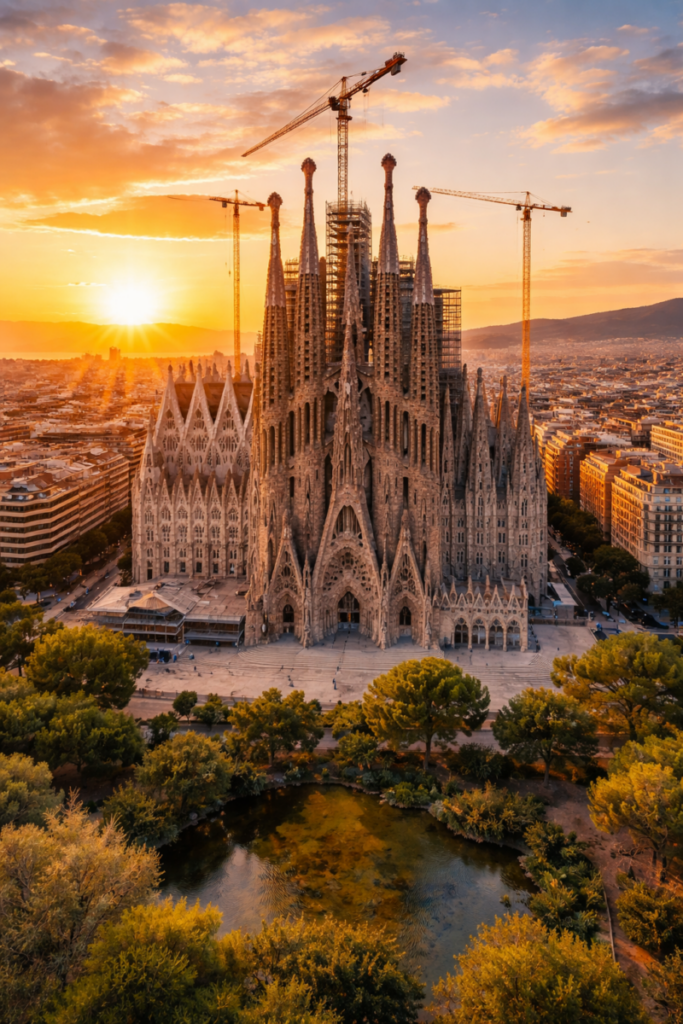
Despite these setbacks, the church never stopped evolving. Funded by donations and ticket sales, it has become the world’s most famous unfinished building. The main structure is expected to be completed around 2026—the centenary of Gaudí’s death—while decorative elements may continue into the 2030s.
II. The Language of Nature: Gaudí’s Spiritual Expression
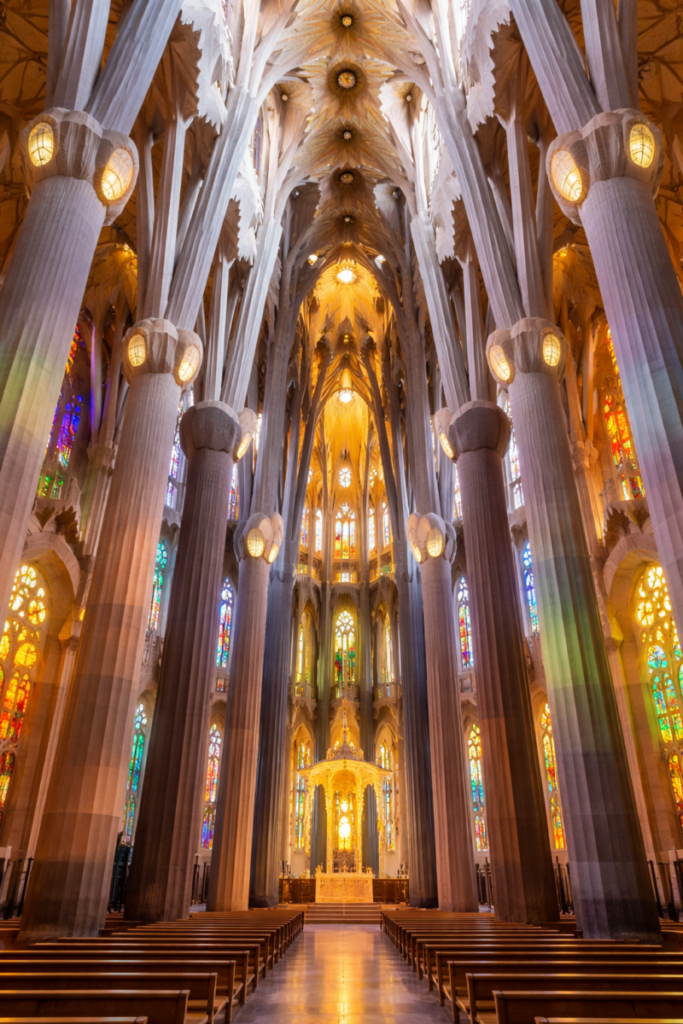
Stepping inside the Sagrada Familia feels less like entering a traditional church and more like walking into a forest of stone.
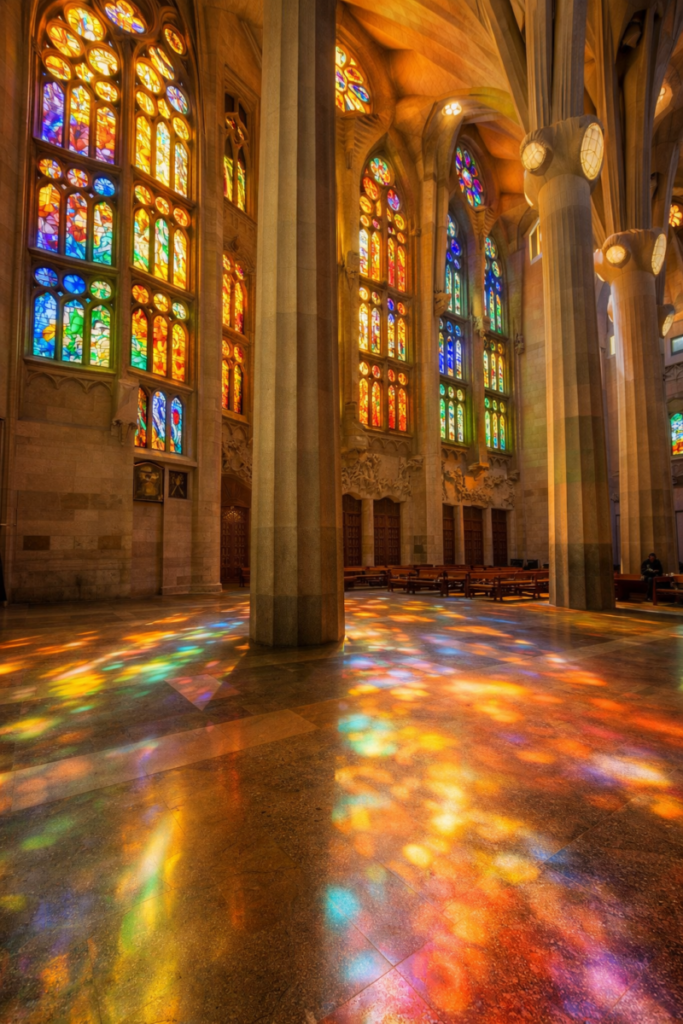
Gaudí believed that nature was the ultimate architect. He translated the branching structure of trees into columns that split and rise to support the ceiling like trunks and branches. Skylights filter light as though it were sunlight passing through leaves, creating a dynamic and ever-changing interior atmosphere.
This was not only an aesthetic choice but also a structural innovation. By employing complex geometries—such as hyperboloids and paraboloids—Gaudí created a self-supporting system that minimized the need for conventional buttresses. This pioneering approach secured the Sagrada Familia’s place as a milestone in modern architectural history.
III. Three Façades: A Bible in Stone
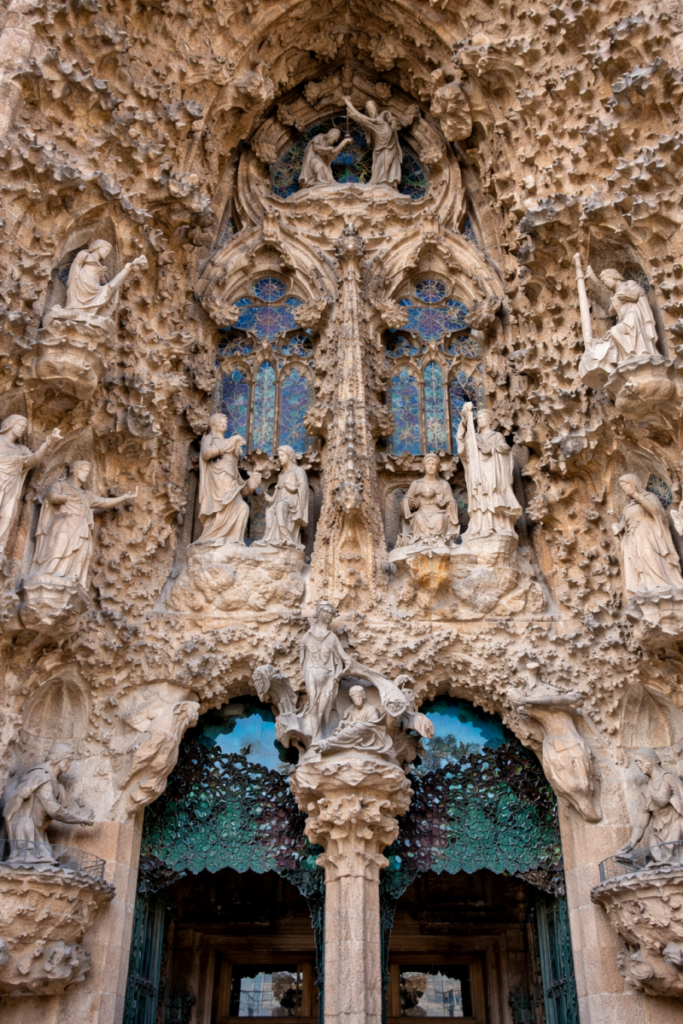
One of the most symbolic features of the Sagrada Familia is its three grand façades, each narrating a different chapter of the Christian story:
Nativity Façade: Richly detailed and full of life, it depicts the birth of Jesus and is the only façade largely completed during Gaudí’s lifetime.
Passion Façade: Stark and angular, it conveys the suffering and crucifixion of Christ with dramatic intensity.
Glory Façade: Still under construction, it will serve as the main entrance and symbolize the path to God.
Together, these façades function as a visual scripture, transforming complex theological ideas into tangible artistic expression.
IV. Eighteen Towers Reaching Toward the Sky
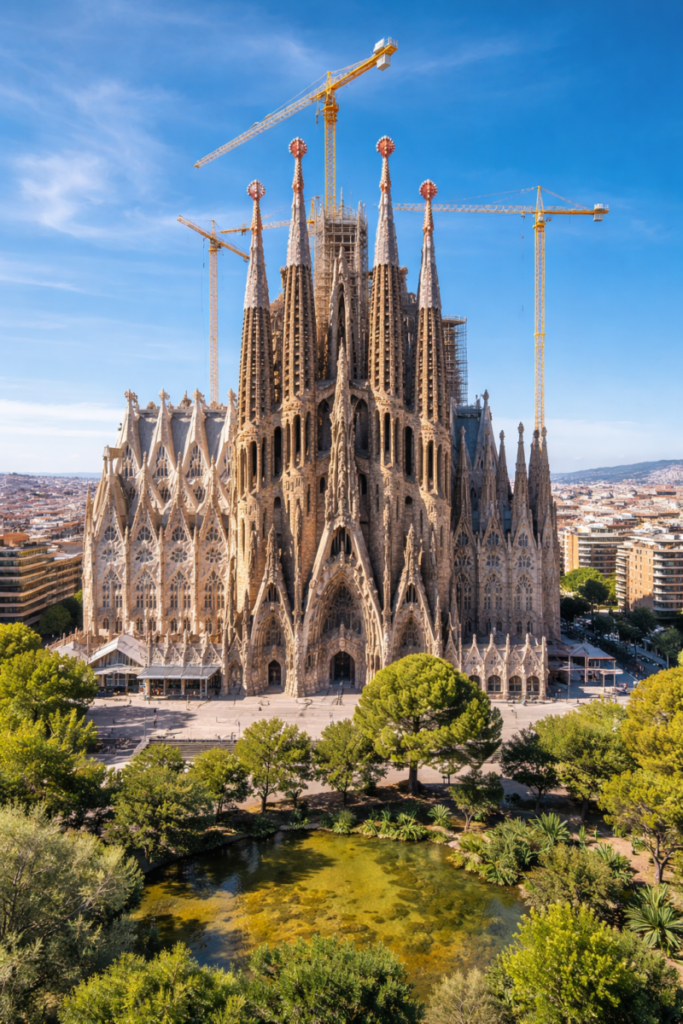
The skyline of the Sagrada Familia is defined by 18 towers, each imbued with symbolic meaning:
12 represent the Apostles
4 represent the Evangelists
1 represents the Virgin Mary
The tallest represents Jesus Christ
The central tower already exceeds 162 meters, making it the tallest church in the world, with a projected final height of around 172 meters.
Notably, Gaudí intentionally designed the structure to remain lower than the nearby Montjuïc hill, reflecting his belief that human creation should not surpass the work of nature.
V. Faith and City: A Symbol of Catalonia
The Sagrada Familia is more than a religious building—it is also a cultural symbol tied to Catalonia’s revival movement. Gaudí seamlessly integrated national identity, spiritual devotion, and artistic innovation into a single monumental form.
Part of the structure was designated a UNESCO World Heritage Site in 1984, and in 2010 it was consecrated as a minor basilica, officially opening it for religious ceremonies.
Today, millions of visitors travel to Barcelona each year to witness this ever-evolving masterpiece—a building that is still, quite literally, growing.
VI. The Beauty of the Unfinished: An Eternal Work in Progress
Perhaps the true charm of the Sagrada Familia lies not in its completion, but in its perpetual state of becoming.
As Gaudí once remarked, “My client is not in a hurry.” That client is both God and time itself.
This extraordinary structure has spanned the Industrial Age, survived war, and entered the digital era. Each stone bears the mark of different generations of craftsmen; each phase of construction is a dialogue between past and future.
The Sagrada Familia is not just a building—it is a living testament to the enduring conversation between humanity, faith, and time.
Related Posts