When it comes to Hetian jade, most people first think of its warmth—warm to the touch, as smooth as suet, as if the tenderness of years has been kneaded into the stone. But for many, Hetian jade is never just a “beautiful stone”; it is a symbol etched in cultural DNA. From the jade cong of the Neolithic Age, to the jade bi of the Shang and Zhou dynasties, and the jade pendants of the Ming and Qing dynasties, Hetian jade has always been associated with “ritual” and “virtue.”
The ancients said, “A gentleman compares his virtue to jade,” equating the jade’s warmth, tenacity, and purity to the character of a noble person. Emperors and generals used jade as imperial seals, symbolizing power and legitimacy; ordinary people wore jade bracelets and pendants, praying for peace and smoothness.
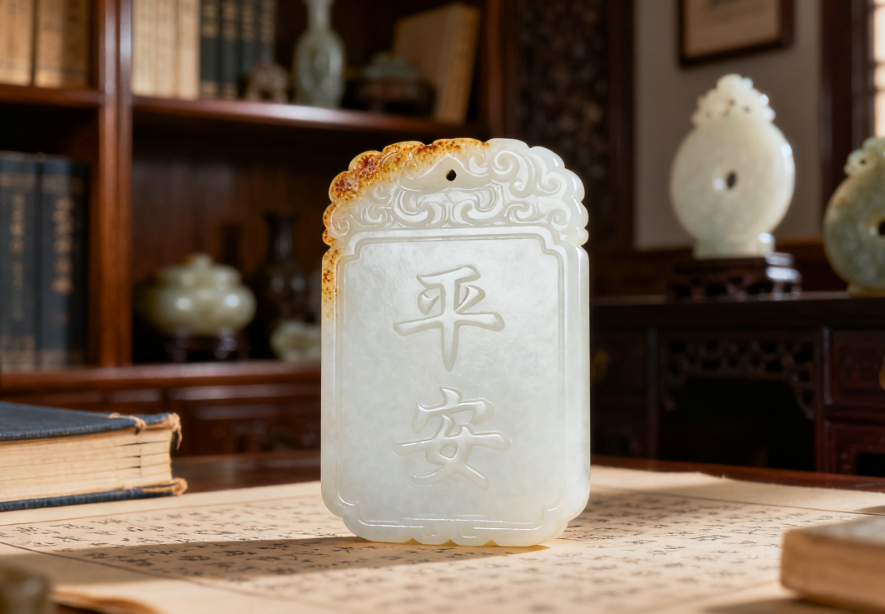
I once saw a Qing Dynasty Hetian white jade seed material pendant in the study of an elderly collector. Carved lightly with the characters “Ping An” (peace), its edges bore a natural golden skin. The elderly collector said: “This jade was passed down from my grandfather. When he fled with his family back then, he lost everything except this jade, which he sewed into his chest. Later, when I was born, he hung it around my neck and said, ‘Jade can protect people, and more importantly, teach them—to be like jade: unassuming yet resilient.’”
It turns out that the value of Hetian jade never lies in its price, but in the emotions and spirit of the Chinese people it carries, serving as an intergenerational “token of faith.”
Today, more and more people love Hetian jade, but many beginners fall into the misunderstanding of “only valuing whiteness”—thinking the whiter the Hetian jade, the more valuable it is. In fact, those who truly understand jade value its “charm” more:
- It is the fineness of the jade texture, whether it feels “as smooth as touching a baby’s skin” when stroked.
- It is the oily luster, whether it glows with a warm, greasy sheen under light, rather than a cold, glassy shine.
- It is the “liveliness” of the color—for example, the white of mutton-fat jade is not a dull or pale white, but a warm-toned “lively white,” as soft as fresh snow on pine branches.
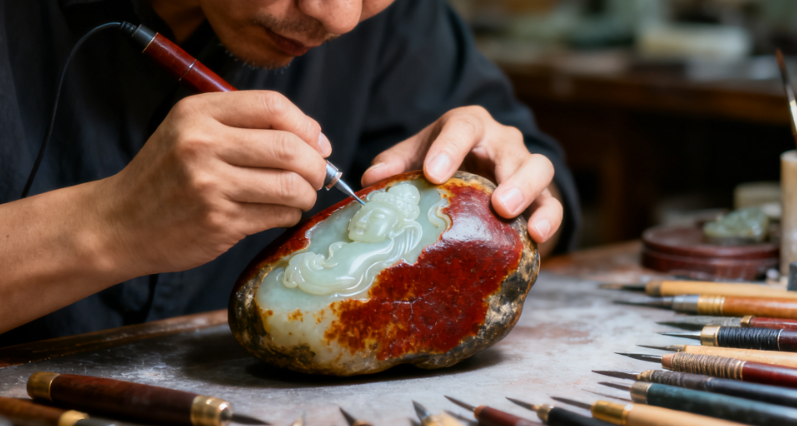
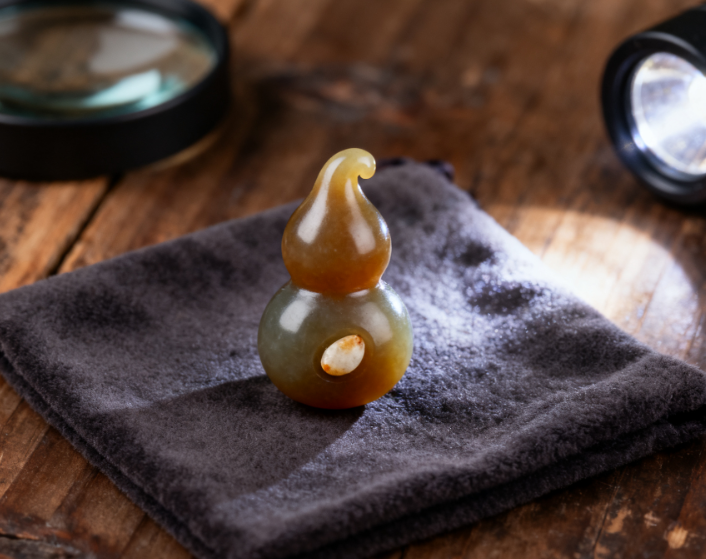
- There is also the skin color of seed materials: golden skin, jujube red skin, and pear skin, unique marks bestowed by nature. A good skin color adds layering to the jade, as if containing the aura of mountains and rivers.
Collecting Hetian jade is divided into “appreciation” and “use”:
- For appreciation, you can collect a piece of seed material raw stone, preserving its most authentic form—some raw stones have natural cracks, resembling the folds of mountains; others have mottled skin colors, like sunset glow reflecting on a river.
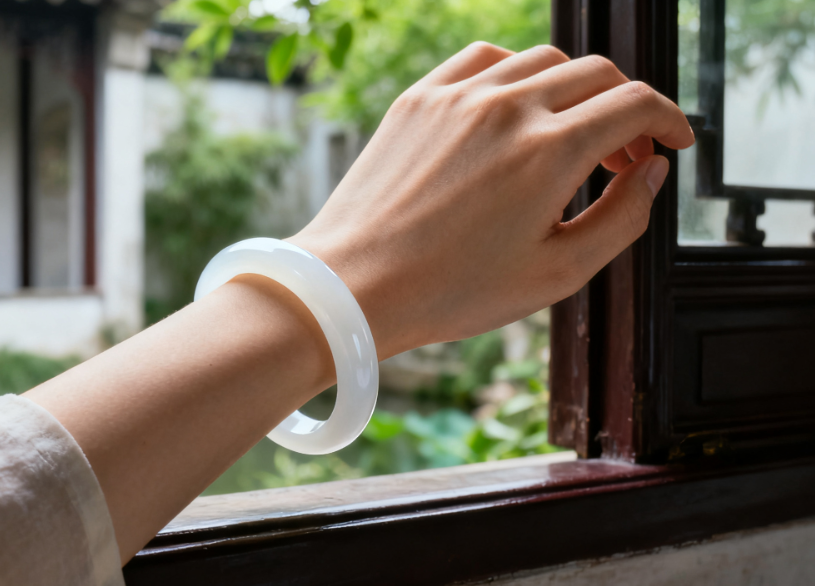
- For wearing, jade bracelets and pendants are classic choices, but “fit” matters: the bracelet’s inner diameter should slide smoothly from the wrist to the forearm, neither loose nor tight; the pendant’s size should suit your figure—small magnolia flower pendants are ideal for daily wear, while elegant flat round pendants (ping’an kou) exude stability.
Whether collecting or wearing, remember: “Jade nourishes people, and people nourish jade.” Wearing and stroking it often allows the jade to absorb human oils, becoming more warm and lustrous; in return, being with jade gradually instills peace in people.
The vitality of Hetian jade lies in its ability to grow with the times—retaining thousands of years of cultural heritage while taking on new forms, making more people willing to keep it close and weave it into their own stories.
Perhaps the charm of Hetian jade lies in its “slowness”—it requires the polishing of time, the understanding of people, and the accumulation of emotions. From an ore in the Kunlun Mountains, to a crafted work by artisans, and finally to the palm of a collector, a piece of jade undergoes thousands of years.